

When Bondeko Refugee Livelihoods Centre first opened its doors in 1997, it existed entirely outside the traditional humanitarian architecture. For years, it was a community-driven initiative operating on the margins—visible to those it served, but invisible to the bigger, funded, resourced humanitarian organisations.
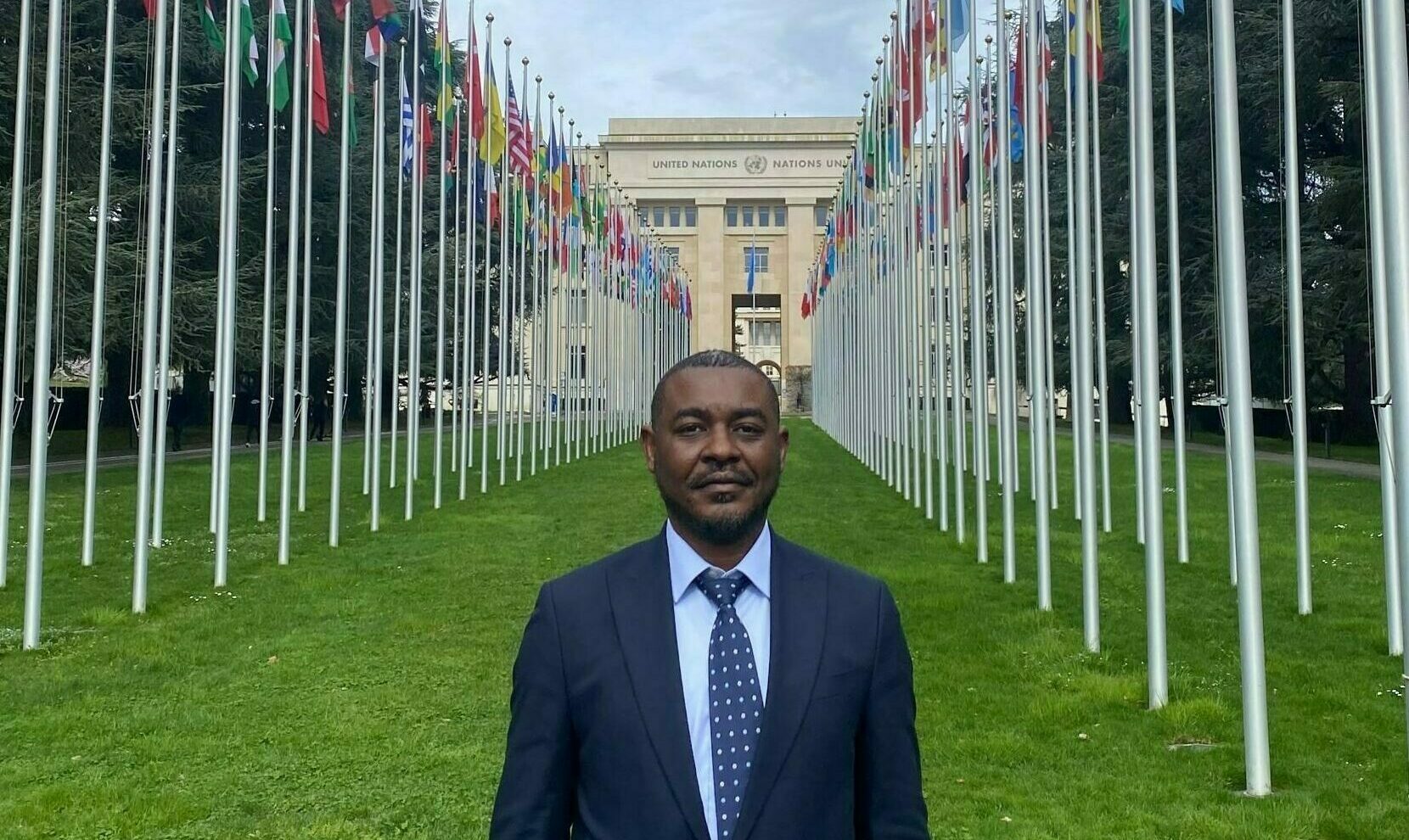
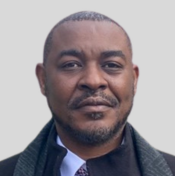
Today, Bondeko is a fully staffed Refugee-Led Organisation (RLO) which reached more than 3,000 people last year alone, and includes a team of 24 paid staff, additional volunteers on allowances, and formal tax registration. The Chief Executive Officer, Paul Kithima, reflects: “People couldn’t believe the transformation.”
This blog traces Paul’s journey—from being excluded from decision-making spaces to standing in the rooms where global refugee policy is shaped. It is a story of persistence, courage, and the growing recognition that meaningful refugee participation (MRP) within localised responses is essential for the future of the humanitarian system.
Starting Outside the System: “No One Acknowledged We Were an Organisation”
In 2018, when Paul stepped into his leadership position at Bondeko, the organisation was still in its formative stage. RLOs were largely considered informal community groups, not legitimate actors. He recalls:
“There was no acceptance of RLOs as first responders. Instead, we struggled to engage with a system that either rejected us, or drew in the most talented refugees and leaders of our communities, often under conditions of hardship, with minimal incentives that made even auxiliary roles as interpreters or volunteers difficult to resist. As an Executive Director of an RLO, I wasn’t accepted to sit with EDs of other NGOs.”
The turning point came gradually. Global policy commitments began to open cracks in the system: the 2016 New York Declaration, the World Humanitarian Summit in Istanbul, the Grand Bargain, and, crucially, the 2018 Global Compact on Refugees (GCR). Paragraph 34 of the GCR became a touchstone for Paul:
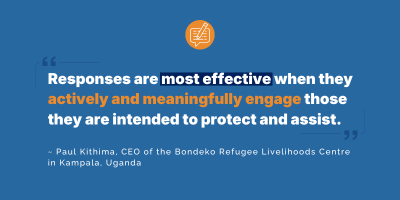
“Responses are most effective when they actively and meaningfully engage those they are intended to protect and assist.”
For the first time, global policy explicitly acknowledged RLOs as legitimate actors.
COVID-19: “A total lockdown, but the community needed us.”
Yet recognition on paper was not enough. It was the COVID-19 pandemic that forced a level of collaboration between RLOs and UN agencies previously unimaginable.
Communities were locked down. Movement was restricted. But desperate messages from his community were still reaching Paul: pregnant women without food, families quarantined with deceased loved ones, households cut off from all support.
He recounts:
“We received small donations through mobile transfers, and we started cash distributions. We took risks by going out. People warned me, saying, ‘The authorities are going to come for you,’ but the community had no one else. Later, to ensure I did not breach the law of the country, I reached out to the same authorities for support, and together we coordinated our efforts. With partners, and with the support of the Police and UNHCR, Bondeko was able to distribute food and many other essential items to more than 1,700 households during that tough period.”
"Because UN agencies could not assume those risks, it was at that moment during COVID‑19 that some of us felt they had the proof of our role. We had the impression that they began to recognise the value of our initiatives and acknowledged that we were, in fact, the first responders."
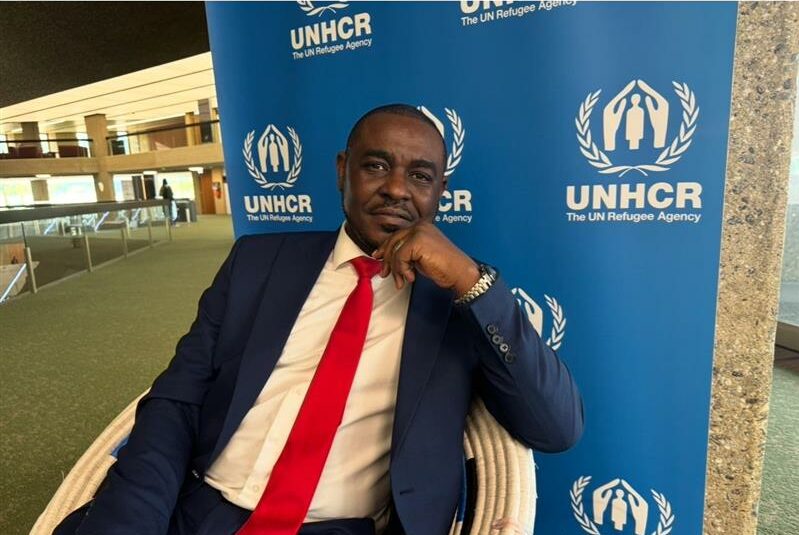
The crisis catalysed coordination among RLOs and grassroots groups. Paul formed a consortium of refugee-led organisations, and global actors began paying attention. Paul’s work was slowly being recognised, and he was invited to join a panel on the topic of localisation during the 2022 UNHCR Global Consultations.
“In the aftermath of the pandemic, as global lockdowns were lifted, it was time to resume international meetings in Geneva. That year, the UNHCR Global Consultations with NGOs focused on the theme of ‘localisation,’ and they sought a refugee who could exemplify localisation in action to speak in Geneva. During that period, someone recognised the efforts I was leading in Uganda and put forward my name. That is how I came to Geneva.”
Finding the Rooms Where Decisions Are Made
Arriving in Geneva felt like crossing an invisible line.
“I discovered where the decision-makers truly are—in those rooms. I knew I needed to return. But securing funding to travel to Geneva for advocacy was another major challenge, since I had to go through Kenya to obtain a visa before coming to Geneva. All those steps required flight tickets, accommodation, and food to be covered. Fortunately, a private donor couple stepped forward to support my advocacy efforts.”
It didn’t take long before a major breakthrough. In 2023, Bondeko became one of the first RLOs to be welcomed into the International Council of Voluntary Agencies (ICVA). This milestone partnership positioned Bondeko as a recognised voice at the global level, providing a platform, stage, and opportunity to bring forward the issues faced at the grassroots level.
Being part of ICVA shifted how other actors perceived refugee leadership, and it showed other RLOs what was possible. Many have since joined ICVA for this reason.
It also highlights the catalytic role of Paul, whose leadership has advanced inclusion and refugee participation in decision-making.
“This is what meaningful inclusion looks like,” he says.
Refugee advocates have always set clear goals for the change they seek. Among them is the call for free movement across borders and the universal recognition of the 1951 Convention Travel Document (CTD)—also known as the Nansen Passport—as a valid instrument for travel. Paul carried this issue forward with persistence. He remained resolute, determined to push beyond the boundaries of what others believed could not be achieved.
Yet multiple challenges to mobility remain, including restrictive processes for refugees to obtain visas. For refugee advocates and leaders, these constraints can mean missed opportunities to participate in critical international forums and attend key high-level meetings—even when their presence is essential and the decisions being made affect their communities.
“Sometimes I test how far we have pushed the limits of our access to rights. I ask for things that others may never have asked for, but that I am entitled to. It is always revealing to see how actors respond."
Gradually, with persistence and presence, people began to believe in Paul’s vision and experience.
Localisation and Meaningful Participation: “You Cannot Separate the Two”
For Paul, localisation and MRP are inseparable, and emphasises that localisation is not a zero-sum game:
“Displacement and statelessness stand among the greatest humanitarian and human rights challenges of our time, directly affecting millions and indirectly touching the entire world. These crises are already spiralling out of control, which is why collective effort is essential. Localisation is the most effective way to drive the response. Yet some actors mistakenly assume that localisation means local actors replacing them. That is entirely wrong. This crisis belongs to all of us, because it affects the whole planet—human beings, animals, ecosystems, climate, and water alike.”
"Localisation must therefore be understood as a shared responsibility. It requires the contribution of all: experience, knowledge, and resources. Only then can it succeed. That is the vision I am championing.” At the same time, and as a refugee himself, Paul reflects that, “I don’t want to be affected by a decision I haven’t been part of.”
A Moment for Change: “Funding Cuts Create Opportunity”
At a time of shrinking budgets, he calls for bold thinking on funding models. Refugee‑led organisations demonstrate that high‑impact, cost‑efficient work is possible when rooted in communities. With just a fraction more resources, their reach could grow exponentially. As the system transforms, RLOs must lead the way, accepted, trusted, recognised, and fully resourced. Yet it is critical to raise the alarm: Localisation must be pursued for the right reason, to build principled and equitable partnerships, not simply as a cost‑saving measure. True localisation is about justice, inclusion, and shared responsibility, not budget reduction.
“If we had more, we could serve more.”
“My Journey to Geneva Started in Kampala”
Looking back, Paul’s path was not defined by strategy sessions or policy frameworks. It started with action, responding to community needs long before the system acknowledged RLOs as actors.
The arc of Bondeko’s growth reflects the possibilities of refugee leadership when given space, and most critically, when overhead costs are covered.
“In the early days, Bondeko had no core funding to provide even small allowances to those who served. It was impossible to retain people when they were most needed, so I filled the gaps myself. I was the CEO, but also the one opening and closing the gate for visitors and cleaning the courtyard. This is the reality for many RLO leaders: without resources to support community volunteers, they are forced to carry multiple roles, while much of the talent in the community is drawn away to jobs with INGOs and humanitarian service providers where salaries are available”.
Bondeko’s turning point came when a private donor couple made a three‑year commitment to cover the core budget, including staff salaries.
“That support allowed us to stabilise, retain staff, and take our programming and actions to the next level”.
This experience has shaped Paul’s advocacy on funding, underscoring the critical importance of overhead costs being covered for RLOs.
He concludes with a quiet determination:
“When I first came to Geneva, I met with fellow refugees. On my second visit, I engaged with new groups I had never met before, and by the third, I encountered yet more unfamiliar faces. Over time, I began to see the true value of returning consistently. Each meeting allowed me to advocate for localisation, and each time I returned to Uganda, I observed how the decisions and commitments made by Member States were being implemented there and across Africa. This enabled me to identify gaps quickly and strengthen my advocacy for the next meeting in Geneva. In the end, my message has become clearer and more compelling to my audience because of this consistency.”
"I believe one of the most effective ways to advance localisation is to identify standard‑bearers in every region and country, support them, and continue reinforcing refugee advocacy at the global level—ensuring consistency through in‑person participation, even in the face of shrinking humanitarian funding."
“Most importantly, I’d conclude by saying that the partnership between ICVA and UNHCR represents a tremendous opportunity to amplify the voices of refugee advocates worldwide. And Bondeko, as one of the co‑conveners of the Multistakeholder Pledge on Advancing Localisation in Displacement and Statelessness Responses, stands as a powerful signal that localisation is advancing.”