-
Search -
Accessibility -
Members Login
International Council of Voluntary Agencies
Dr Jamie Munn, Executive Director & Nimo Hassan, Board Chair
Humanitarian action is not sustained by funding alone, but by shared values and unwavering solidarity with people in crisis.
If we were to choose one phrase to describe 2025, it would be a year of hard realities and steadfast resolve.
Across the globe, humanitarian needs – driven by protracted conflicts, climate-related disasters, displacement, and deepening economic fragility – continued to rise. Resources and political space did not keep pace. Commitments to localisation and equitable partnership remained strong in principle, but too often fell short in practice.
For many NGOs, this was a year marked by difficult decisions, operational strain, and deep concern for the communities they serve.
Yet, amid these pressures, we also witnessed extraordinary commitment. NGOs – local, national, refugee-led, and international – continued to deliver life-saving assistance, advocate for protection and rights, and adapt to increasingly complex environments.
In this context, ICVA focused on its core purpose: strengthening collective NGO impact.
Throughout 2025, ICVA worked to ensure that the voices and operational realities of NGOs informed policy and coordination discussions. Engagement with UN agencies, donors, and inter-agency platforms remained a priority, particularly on issues related to humanitarian financing, protection, forced displacement, and the role of local and national actors.
Together with our members, ICVA continued to push for more direct, flexible, and predictable funding for local and national organisations, as well as simpler and more proportionate compliance requirements. While progress was uneven, sustained collective advocacy ensured these issues remained central to system-wide reset efforts.
For ICVA itself, 2025 required careful stewardship. Financial uncertainty across the sector affected the Secretariat as well as our members. We prioritised maintaining essential services to the network: policy analysis, coordination support, regional engagement, and representation in global fora. We are deeply grateful to our staff for their dedication and professionalism, and to our donors and members whose flexible support enables ICVA to remain responsive in challenging times.
What stands out most, however, is the strength of the ICVA network. Members across all regions continued to share information, shape collective positions, and support one another through working groups, consultations, and peer exchange. In a year when fragmentation would have been understandable, collaboration prevailed.
We do not underestimate the scale of the challenges facing the humanitarian system. Structural funding constraints, geopolitical tensions, and growing needs will continue to test our collective capacity. But 2025 has also reaffirmed the essential role of a connected, principled, and diverse NGO community. In essence, we have proven the importance of having a global network that can bring those voices together.
As we look ahead, ICVA remains committed to working with its members and partners for a humanitarian system that is more equitable, more locally led, and firmly grounded in the dignity and rights of people affected by crisis.
To our members, partners, donors, and colleagues: thank you for your trust, your engagement, and your solidarity throughout this demanding year.
Key achievements and impact across ICVA’s three strategic priorities
ICVA’s global network entered 2025 with new strategic priorities for 2025-2027, aimed at strengthening NGO leadership, influence and effectiveness across our three core focus areas:
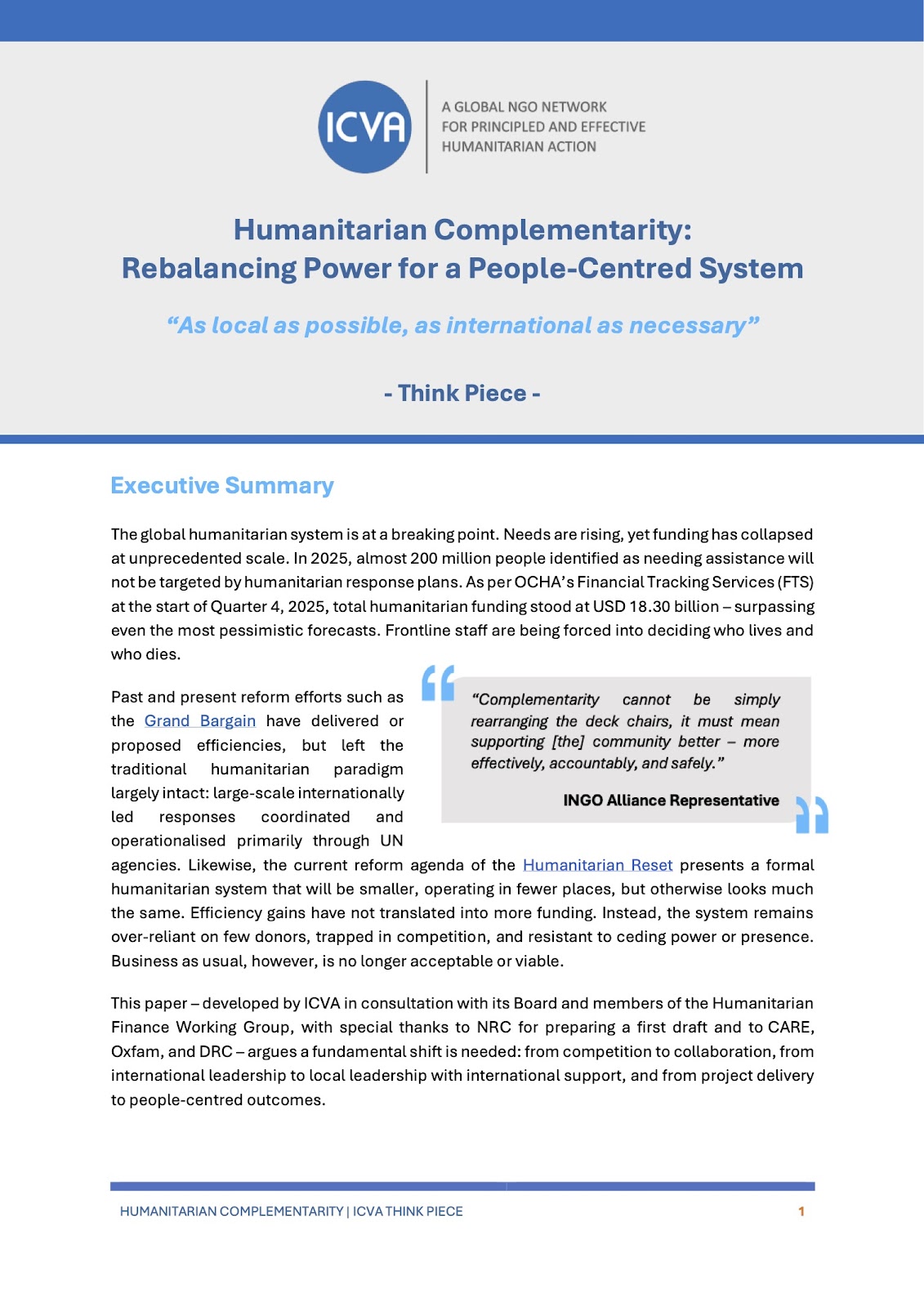
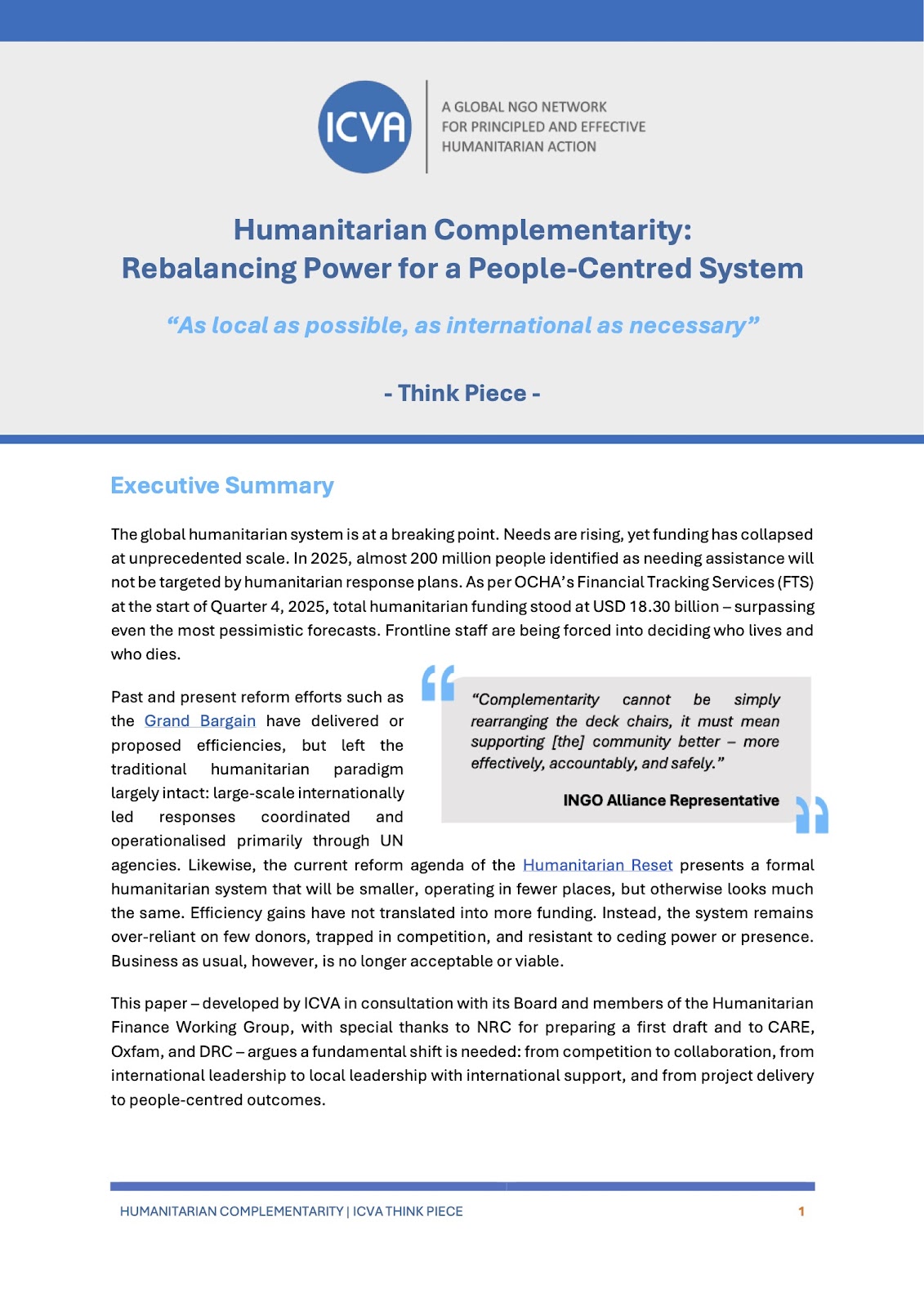
These priorities proved immediately critical. The closure of USAID and broader reductions in humanitarian funding triggered widespread programme cuts, disrupted assistance to crisis-affected communities, and intensified pressure on humanitarian principles, protection frameworks, and locally led response. At the same time, major reform efforts, including the IASC Humanitarian Reset and the UN80 initiative, began reshaping how the humanitarian system is coordinated, financed, and organised. NGO perspectives were largely absent from early Reset decisions, communications, and workstream designs, limiting reflection of operational realities and the implications for crisis-affected people.
In response, ICVA rapidly mobilised its global network to ensure NGOs remained informed, coordinated, and able to shape emerging reforms. We tracked and evidenced the impacts of funding shocks and reform initiatives, organised collective NGO positions, and translated that collective voice into influence across the key reform processes reshaping coordination, financing, and refugee responses.
The suspension and termination of most USAID funding in early 2025 had immediate and severe consequences for crisis-affected people. ICVA helped members and decision-makers understand the changes and their impacts on crisis affected people, frontline responders and system capacity, by:
As funding cuts and political pressures intensified, ICVA helped NGOs maintain coordinated, principled engagement by:
As coordination structures were transitioned and planning processes were redefined, ICVA ensured NGOs remained informed and better positioned to influence key decisions by:
These efforts helped ensure NGO perspectives were reflected in coordination reforms and strengthened their operational relevance.
As pooled funds and financing reforms became central to sustaining humanitarian response, ICVA ensured NGO priorities shaped financing decisions by:
By October 2025, pooled funds had directed over half of recent allocations to local actors, and system leaders endorsed reforms promoting locally led response and more inclusive financing approaches.
As funding cuts and institutional reforms reshaped refugee responses, ICVA ensured NGOs and refugee-led organisations remained engaged in governance and coordination processes by:
Through this sustained engagement, ICVA contributed directly to UNHCR’s reprioritisation approach, helping ensure decisions were informed by operational realities and protection needs. This engagement has also strengthened the foundation for continued NGO participation as response tools are revised and partners develop shared frameworks for assessing humanitarian and protection needs.
18 March 2025
ICVA held its 20th General Assembly online on 18 March 2025, providing members with an opportunity to review ICVA’s work, exchange perspectives, and help shape the organisation’s future direction.
The General Assembly reaffirmed ICVA’s governance oversight, financial accountability, and strategic direction, ensuring continued member stewardship of the organisation during a period of significant humanitarian system change.
Supporting NGOs to understand, shape, lead and participate in the humanitarian system
Effective humanitarian response depends on the capacity of NGOs to deliver principled, timely, and contextually appropriate assistance. Strengthening this capacity—particularly among local and national actors—is essential to ensuring responses reflect the needs and priorities of crisis-affected communities.
ICVA aims to create the conditions that enable NGOs to operate effectively and influence the systems that shape humanitarian response. This includes convening NGOs to exchange expertise, strengthening collective engagement in policy and coordination processes, and supporting structures that enable more equitable and effective participation – particularly for local and national actors.
A central pillar of ICVA’s work is advancing locally led humanitarian action. ICVA advocates for the leadership of local and national actors in humanitarian planning, financing, coordination, and governance, helping ensure their perspectives, expertise, and priorities are reflected in system-level decisions.
Through our Communities of Practice, NGO fora support, and targeted initiatives, ICVA provides platforms for peer exchange, collective analysis, and practical engagement with donors and UN agencies. These efforts help ensure NGO capacity is recognised, connected, and able to shape humanitarian action at global, regional, and country levels.
Generating & Leveraging NGO Capacity
ICVA’s Communities of Practice (CoPs) and Working Groups bring together NGO practitioners to share knowledge, develop collective positions, and drive advocacy on key humanitarian issues. In 2025, these networks continued to grow in membership and influence across the humanitarian system.
Generating & Leveraging NGO Capacity
Throughout 2025, ICVA worked to support local and national NGOs capacity to meaningfully engage in financing, governance, policy, and coordination processes through strategic convening, technical support, and targeted initiatives:
ICVA supported local and national actors to strengthen their ability to assess localisation progress and engage in coordination and policy discussions using evidence and practical tools. This included:
As displacement policies and coordination approaches evolved in 2025, ICVA supported NGOs, in particular refugee-led organisations, to engage more effectively in shaping responses and protection frameworks.
With voluntary returns and resettlement high on the agenda, ICVA supported NGOs to exchange analysis and stay informed on emerging developments by:
In support of the Global Refugee Forum Multistakeholder Pledge on Advancing Localisation in Displacement and Statelessness Responses, ICVA launched a pilot initiative to strengthen the capacity of refugee-led organisations through mentoring and targeted financial support. This included:
ICVA strengthened the ability of local and national NGOs to participate in pooled fund governance and access humanitarian financing, particularly through the CBPF Resource Facility and targeted national and global initiatives.
Through the CBPF Resource Facility, ICVA supports local and national NGOs to strengthen their participation in pooled fund governance and financing discussions. This included:
ICVA supported national NGO networks in Bangladesh to improve local NGO access to humanitarian financing. This included:
Through its partnership in the LOCAL project, ICVA supported efforts to reduce systemic compliance barriers affecting local NGOs. This included:
Generating & Leveraging NGO Capacity
In a year marked by system disruption and funding contraction, ICVA’s NGO Fora Support Programme supported NGO fora to strengthen governance, coordination engagement, and collective representation and voice. By reinforcing structures, supporting leadership, and fostering peer exchange, ICVA continued to ensure NGO fora remain credible, accountable, and effective platforms for principled humanitarian action.
ICVA provided targeted technical support to strengthen governance, accountability, and leadership structures across NGO fora. This included:
To enhance NGO participation in country-level coordination and reset discussions, ICVA hosted monthly NGO Fora exchange meetings and regular online exchanges and direct support. ICVA provided six NGO Fora with tailored trainings.
Iraq: Through a DRC-supported initiative, ICVA supported the establishment of the Network of Iraqi Organisations for Coordination and Cooperation. This included the development of governance structures, membership policies, and operating procedures; training of 25 Iraqi NGOs; securing funding for 18 months to support network sustainability; and formal registration process initiated.
Syria: ICVA supported the consolidation of Syrian NGO coordination structures by facilitating coordination and dialogue among Syrian NGO networks; supporting the unification of hub-based fora into a consolidated Syria NGO Forum; and supporting collective engagement through the Syrian Humanitarian Action and Recovery Conference, involving over 150 civil society representatives.
Yemen: Under an IRC sub-grant, ICVA strengthened the Yemen National NGO Forum and local actors through capacity-sharing based on assessments; strengthened Steering Committee governance; improved clarity on roles and decision-making mechanisms; and reinforced accountability and partnership principles.
The experience exchange in Amman was very important to us. The networks represented were older than ours. So, we learned from them about how to survive, their structures, and when we returned, we revised our bylaws based on the learning.
MENA Regional NGO Fora Exchange Participant
ICVA strengthened regional NGO coordination platforms and leadership, including:
Shaping the global humanitarian policy landscape through evidence-based advocacy
ICVA’s thought leadership across our three core focus areas drives systemic change. In 2025, we delivered concrete policy wins and system reforms through strategic engagement and member mobilisation.
NGO Thought Leadership
ICVA’s 2025-2027 ambitions in forced displacement policy and advocacy are to:
In 2025, ICVA strengthened the meaningful participation of NGOs including refugee-led organisations (RLOs) across key global platforms and processes on forced displacement. We also engaged policies and practice related to internal displacement, protracted displacement contexts, migration pathways, and asylum systems.
In 2025, ICVA deepened and expanded collaboration with key stakeholders, including UNHCR, UN Member States, the World Bank Group, IOM, the Economic and Social Council (ECOSOC), and the UN Special Rapporteur on the Human Rights of IDPs.
ICVA leveraged its standing collaboration with UNHCR to help secure NGOs, RLOs, and organisations led by stateless persons a more consistent seat and role at key decision-making tables.
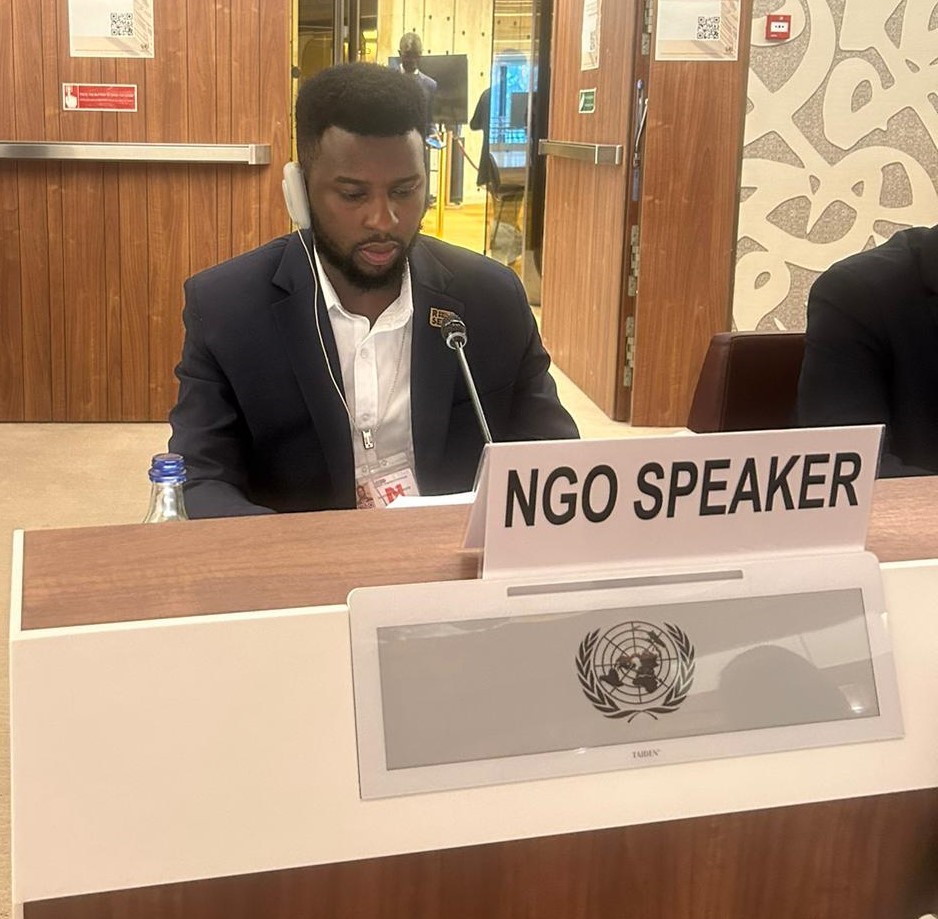
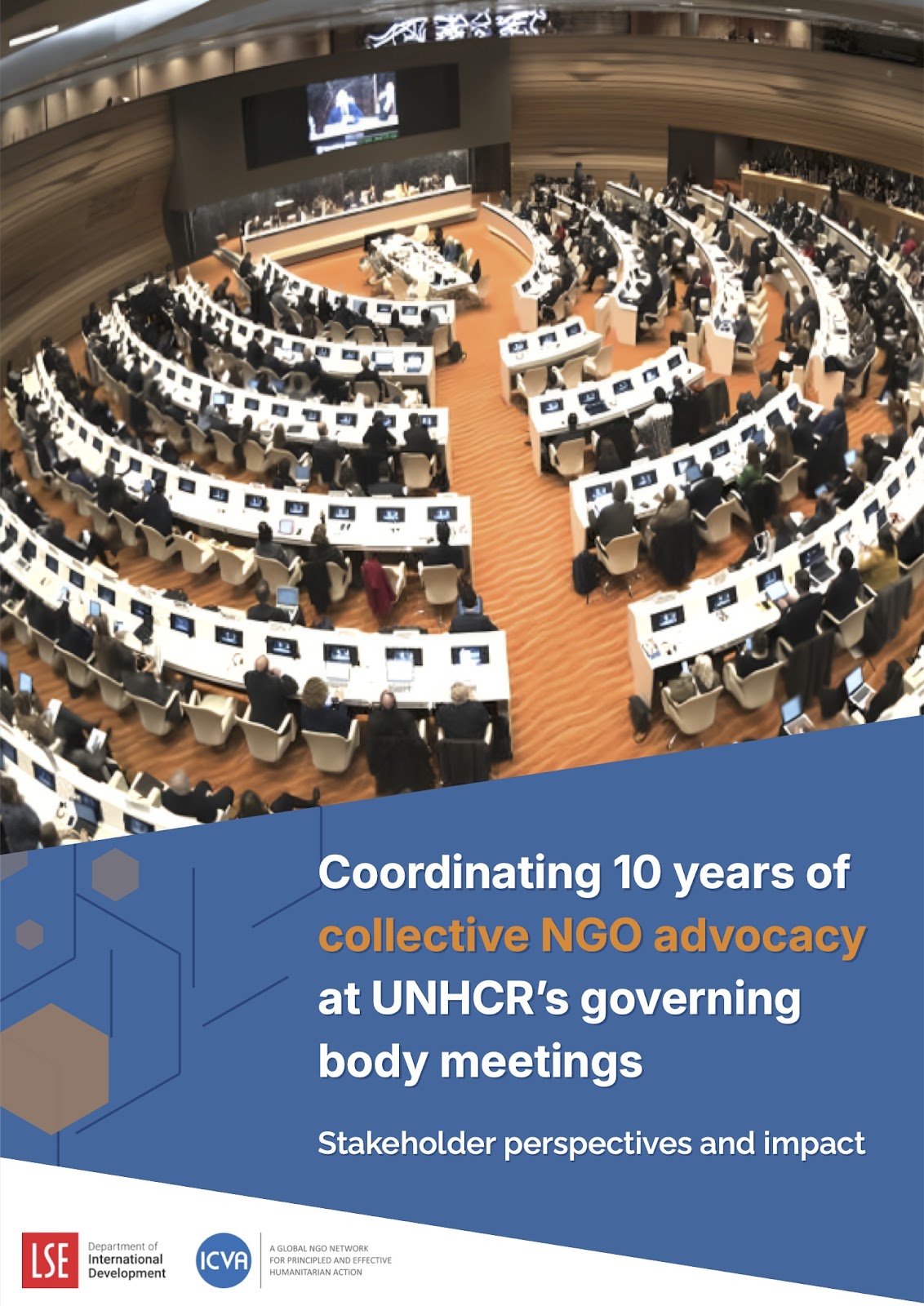
In 2025, 14 collective NGO statements were delivered across three UNHCR Standing Committee meetings and the annual Executive Committee meeting. ICVA provided coordination and technical support to facilitate the development of almost all NGO statements, and ensured increased RLO engagement in the drafting process.
As part of UNHCR’s 76th Executive Committee session, ICVA organised a side event on Refugee Leadership: Redefining Localisation in Humanitarian Action, highlighting how refugee leaders are redefining localisation in practice, moving beyond participation toward transformative leadership.
The 2025 statements reflected NGO experience of record displacement, shrinking humanitarian space, strained asylum mechanisms, and unprecedented budget shortfalls undermining critical programmes. Positive experiences from refugee laws in countries such as Uganda or Kenya were also noted to highlight good practice where it is found. Throughout the year, ICVA and members called on UNHCR and UN Member States for: more funding directed to RLOs and organisations led by stateless persons; more decisive action on durable solutions, including resettlement and complementary pathways; deeper community-based protection; the promotion of sustainable and equitable partnerships with frontline organisations; and country- and region-specific approaches to protracted displacement.
ICVA also commissioned a report assessing the effectiveness of NGO collective statements in UNHCR governing bodies, showing that across a decade of meetings (2015-2024), NGO interventions have contributed to shaping the discourse on key thematic areas, an important outcome for influencing policy.
ICVA partners with UNHCR to convene and facilitate NGO partnership, interaction, and exchange with the agency. In 2025, consultations were held at regional level, supported by an ICVA-backed concept note on safeguarding asylum and strengthening protection as global issues affecting all regions where NGOs and UNHCR operate.
Despite significant challenges in 2025, consultations proceeded through a mix of targeted and open sessions, stretched throughout the year in some regions. In total, over 650 participants engaged across regional consultations in the Americas, MENA, East Africa, Europe, and Asia-Pacific (AP). ICVA co-convened consultations for Europe, MENA and AP, and was actively involved in East Africa.
Recommendations presented to UNHCR’s Executive Committee reflected regional priorities, including:
Route-Based Approaches (RBA) were also discussed in Europe, AP, and East Africa, generating recommendations on strengthening cross-border coordination; harmonising procedures, referral systems and case management; recognising the role of civil society in asylum systems; addressing root causes of unsafe onward movements; and expanding third-country solutions to reduce reliance on dangerous routes.
Outcomes from the 2025 regional consultations will feed into the 2026 global consultations.
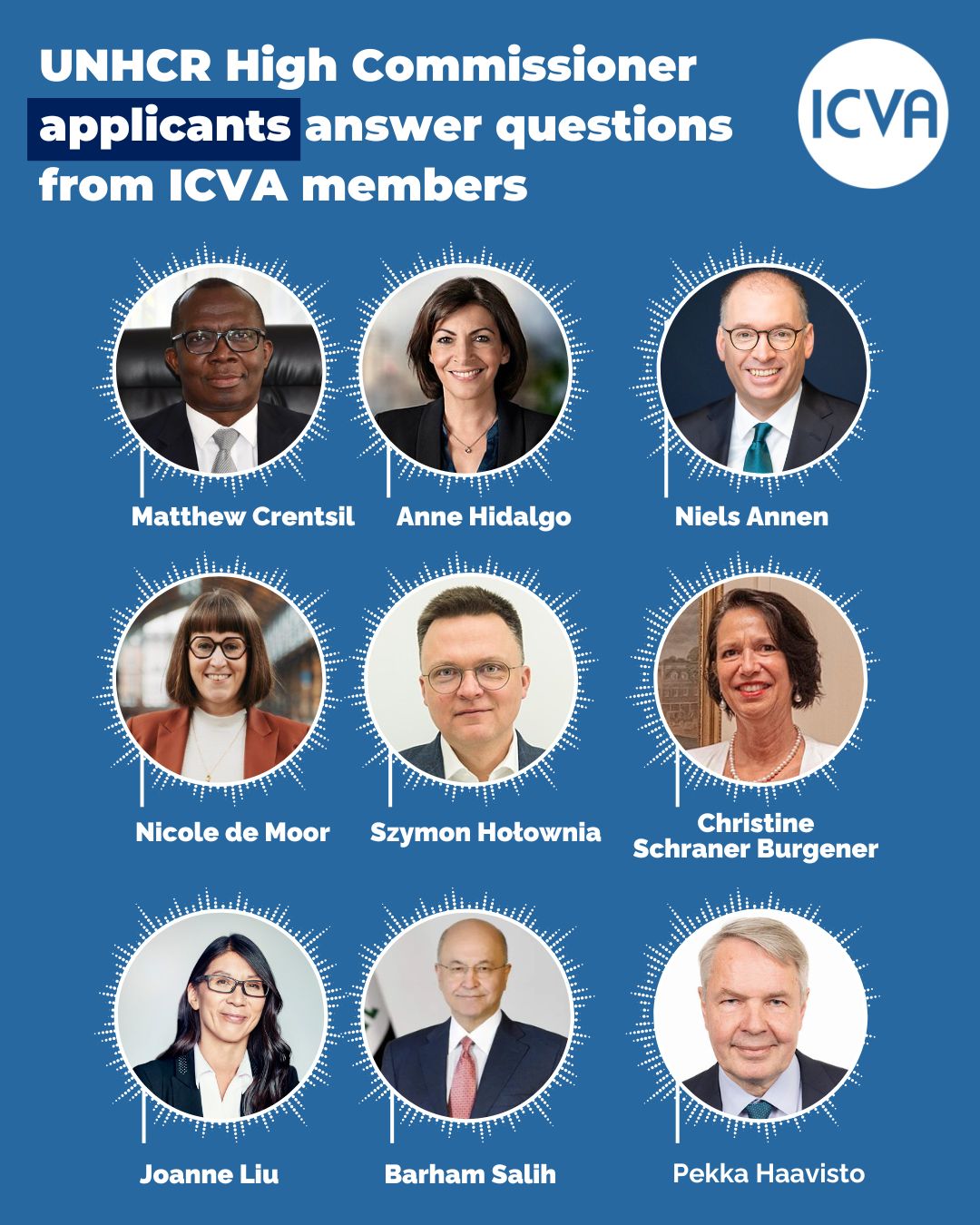
ICVA continued its long-standing commitment to transparency and accountability in selecting the UN High Commissioner for Refugees. ICVA invited candidates to meet members to present their vision and discuss NGO priorities and perspectives on UNHCR’s work; five candidates accepted. We also met bilaterally with additional candidates and supported one candidate debate during an R-Space event.
ICVA further invited candidates to respond to five member-consulted questions. Eleven candidates shared views on: their vision for UNHCR; priorities in UNHCR’s restructuring process; strategies to rebalance power to enable meaningful participation of forcibly displaced and stateless persons; approaches to uphold and reinvigorate the refugee protection regime; and ideas to strengthen UNHCR’s core mandate while working more effectively across the humanitarian-development-peace nexus.
Beyond UNHCR governance settings, ICVA created opportunities for members to engage with UNHCR’s regional bureau for Europe, partnerships and RCM teams on the Reset, Global Refugee Forum pledges, and other technical discussions, advancing issues of concern through additional channels.
ICVA complemented UNHCR engagement with dialogues with UN Member States to pursue multiple avenues to influence forced displacement policies and practice at national, regional, and global levels. Member States’ requests for ICVA technical support on humanitarian strategies reflected confidence in ICVA’s approach and expertise.
ICVA also continued engagement with the World Bank Group through the UNHCR-World Bank Joint Data Centre on Forced Displacement, supporting NGO access to data and analysis. Members informally exchanged with the World Bank Group on two occasions to hear updates, discuss the Bank’s International Development Association and Global Concessional Financing Facility, and review NGO priorities.
ICVA members exchanged twice with the UN Special Rapporteur on the Human Rights of IDPs, Ms. Paula Gaviria Betancur, as she contributes to addressing the complex problem of internal displacement. Building on this engagement, ICVA and the SR are overseeing research on the impact of the funding cuts on the human rights of IDPs in South Sudan and Haiti, to be launched in 2026.
ICVA continued informal dialogues with IOM in 2025, including: a briefing organised together with UNHCR on RBA developments and joint advocacy opportunities; and an IOM-NGO briefing, as in previous years.
Finally, the 2025 Humanitarian Network Partnership Weeks provided a platform for ICVA to emphasise the importance of RLOs through a session entitled “Passing the Baton – Refugee and Local Leadership in Refugee Responses”, attended by over 80 participants.
2025 marked the GRF 2023 Progress Review.
Since 2023, ICVA has co-convened with UNHCR the Multistakeholder Pledge on Advancing Localisation in Displacement and Statelessness Responses. The pledge aims to address challenges related to local and national actors’ funding, participation in decision-making, capacity-sharing, and advancing localisation in policy and partnerships. It has 45 pledges submitted by national and international NGOs, UN Member States, international organisations, and the private sector; over USD 100 million committed; and targets over 900 CSOs globally, including 55% led by displaced and stateless persons.
In 2025, Bondeko Refugee Livelihoods Center joined ICVA and UNHCR as Co-Lead. Together, we continued promoting the pledge, supporting mobilisation, and tracking implementation progress. We convened the pledge’s 19 Reference Group members and Signatories to take stock of progress and discuss the Progress Review meeting and related events.
ICVA is also a Signatory of the GRF Multistakeholder Pledge on Meaningful Refugee Participation. We regularly attended signatory meetings and contributed to developing an approach to mainstream meaningful refugee participation across multistakeholder pledges.
Ahead of the Progress Review meeting (December 2025), ICVA shared GRF information (including through a blog series), regularly exchanged with UNHCR and pledge partners, and participated in four preparatory meetings to clarify the focus, programme, and intended outcomes while assessing pledge implementation progress.
ICVA launched, together with R-SEAT and Bondeko Refugee Livelihoods Center, a global survey on RLO perspectives on leadership. Early findings pointed to improved inclusion of RLOs in decision-making, while major gaps remained in RLO access to funding. ICVA and partners also prepared four Progress Review-related events.
The GRF Progress Review meeting (15-17 December, Geneva) brought together nearly 1,500 participants from around 150 countries. ICVA’s collective NGO statement highlighted protection backslides and the collapse of resettlement and complementary pathways, and urged a surge in funding, including for locally-led and refugee-led responses.
ICVA’s linked and side events, attended by close to 300 participants, included:
Following the end of the mandate of the Special Advisor on Solutions to Internal Displacement, 2025 saw the establishment of global institutional arrangements around UN support to nationally led internal displacement solutions. ICVA became a member of the Global Solutions Working Group (GSWG), made up of operational agencies engaged in solutions programming at country level. ICVA ensured that additional NGOs gained seats in the GSWG by helping to identify suitable organisations. The GSWG endorsed a roadmap, with initial country situations focused on Colombia, Mozambique, and Sudan.
Throughout 2025, ICVA also lobbied across fora and stakeholders to maintain focus on internal displacement solutions amid funding reductions, restructuring, and response reprioritisation.
ICVA strengthened NGO capacity to engage in Route-Based Programming by creating structured opportunities for NGOs to engage directly with UNHCR and IOM and contribute to emerging coordination and protection approaches. This resulted in:
In the face of threats to international humanitarian and human rights law in advance of the UN General Assembly, ICVA coordinated global advocacy campaigns with over 300 NGOs calling on UN Member States to uphold, preserve, strengthen, and celebrate international and regional refugee treaties.
The Gaza crisis was one of the Forced Displacement Working Group’s priority advocacy contexts in 2025. ICVA amplified member voices by elevating expertise and recommendations to strengthen Gaza-related advocacy, particularly through social media and ICVA, collective NGO, and NGO leaders’ statements.
On 12 December 2024, the Cartagena+40 Process adopted the Chile Declaration and Plan of Action 2024-2034. ICVA attended the commemoration event in Santiago, Chile. Since adoption, attention has focused on maintaining multi-stakeholder engagement, including through a follow-up mechanism integrating States, the Technical Secretariat, academia, NGOs, RLOs, and refugees. This creates an opportunity for ICVA to continue promoting local and national NGO leadership through NGO fora and to support reflection and collaboration to advance implementation.
The Regional Refugee and Resilience Plan (3RP) remains the principal platform for humanitarian and development partners responding to the Syrian refugee crisis (for refugees and host communities). Co-led by UNHCR and UNDP, it operates in Turkey, Lebanon, Jordan, and Egypt, and brings together over 270 partners under unified humanitarian and development coordination structures.
ICVA is a member of the Regional Technical Committee and Regional Steering Committee, amplifying NGO voices and contributing to agenda-setting and planning. In 2025, ICVA contributed NGO inputs to Steering Committee work. The annual 3RP Regional Planning Workshop in September connected durable solutions, localisation, and funding reductions with developments in Syria to inform 2026 regional planning. The workshop also convened UNHCR partners as part of the MENA Regional Consultations with NGOs, including a dedicated localisation session supported by ICVA.
NGO Thought Leadership
ICVA’s 2025 to 2027 ambitions in humanitarian financing policy and advocacy are to improve levels and access to financing, strengthen funding quality, and manage risk.
The funding shocks of 2025 created an opportunity to influence structural reform in humanitarian financing. ICVA engaged the Reset, the Grand Bargain, donor repositioning and UN partnerships as entry points to support a shift towards more equitable and effective financing.
ICVA’s sustained engagement on pooled funds positioned the network as a recognised thought leader in 2025. Alongside formal engagement in the Reset and Grand Bargain, ICVA informally supported donors and humanitarian actors to reflect on pooled funding architecture and future directions.
In 2025, ICVA strengthened its pooled fund work through:
Together, this work addressed knowledge gaps and contributed to practical solutions to diversify humanitarian financing.
ICVA advanced access and quality of financing for local and national actors through pooled fund reform and broader engagement in global financing processes.
In 2025, ICVA:
These efforts strengthened collective NGO positioning on funding quality, intermediary roles and equitable partnerships.
ICVA explored innovative financing arrangements, including debt swap instruments and social enterprise models, to diversify humanitarian funding sources.
In February, ICVA organised a webinar on Innovative Funding and Pooled Funds in East and Southern Africa. Fifteen members exchanged on emerging trends, challenges and opportunities, including experiences from Kenya, Somalia, and South Sudan.
Preparatory work began for a dedicated Working Group to deepen engagement on innovative financing in 2026.
In 2025, ICVA assumed the NGO Representative role within the Grand Bargain Facilitation Group alongside the Alliance for Empowering Partnership.
ICVA co-convened seven NGO Constituency meetings to shape discussions on humanitarian system reform and the future of the Grand Bargain beyond 2026. It also co-hosted, with partners, a networking event during the Annual Meeting.
NGOs called for coherence across global reform processes, stronger country-level impact, clarity on intermediary roles, and closer connection between Grand Bargain commitments and operational realities.
ICVA initiated consultations with NGO Signatories to gather recommendations across 12 Grand Bargain workstreams, including quality funding, localisation, risk-sharing, participation and collective advocacy.
Within the Facilitation Group, ICVA will co-lead a consultative process to design an evolved Grand Bargain framework that strengthens accountability and accelerates reform.
ICVA also co-developed and convened a High Level Roundtable with the Grand Bargain Secretariat, IFRC and Qatar Charity on investing in the institutional development of local and national NGOs. The dialogue brought together philanthropy, development banks, government donors, UN actors and NGOs to explore scalable investment models and new financing vehicles.
ICVA contributed to the annual Grand Bargain self-reporting process, reporting on quality funding, localisation, participation and risk-sharing commitments.
ICVA and its members contributed qualitative analysis and recommendations to two CERF prioritisation rounds, supporting informed allocation decisions for underfunded humanitarian emergencies.
ICVA strengthened transparency and evidence-based reform by:
This work supported improved data transparency while advocating for proportionate reporting requirements.
ICVA continued to create structured spaces for dialogue and guidance to strengthen partnership practices between international, local and national NGOs and UN agencies.
ICVA organised a follow-up workshop to advance advocacy collaboration between UNICEF and NGO partners, engaging 50 participants. It also hosted a webinar attended by over 100 partners to present UNICEF’s updated CSO-Facing Handbook, incorporating NGO inputs.
In April, ICVA facilitated an exchange between members and UNICEF leadership to discuss positioning in relation to the Reset.
I am impressed that we got this through with senior management buy-in in less than 2 weeks.
On the efficiency of the HFWG’s work on the WFP Partnership Pact
ICVA continued long-standing engagement with WFP on Field-Level Agreements.
In 2025, ICVA:
The Partnership Pact establishes shared principles and practical commitments to strengthen collaboration with NGO partners.
Throughout the year, ICVA engaged bilaterally and multilaterally with donors, including through the Grand Bargain, to convey NGO perspectives on funding gaps, financing reform and future funding architecture.
As funding pressures intensified, ICVA strengthened support to members on risk management and protection of humanitarian space.
ICVA participated in the IASC Community of Practice on Preserving Humanitarian Space, contributing member inputs on sanctions and restrictive measures in Syria and supporting engagement on reporting linked to UN Security Council Resolution 2664.
ICVA also:
These efforts supported more coherent risk-sharing approaches and reduced compliance burdens for frontline organisations.
NGO Thought Leadership
Across three IASC Principals meetings in 2025 (19 February, 17 June and 28 October), ICVA was represented by:
Discussions focused on responding to the humanitarian funding contraction and erosion of political support that shaped the Humanitarian Reset.
ICVA conveyed consolidated NGO feedback on the Reset’s priority areas, including the emphasis on hyper-prioritising life-saving action, reducing coordination layers and duplication, preserving essential common services, devolving decision-making and resources to country-level leadership, and the related use of pooled funds.
In its interventions, ICVA underscored the need to defend humanitarian principles and International Humanitarian Law, and to maintain protection and gender equality commitments. ICVA called for sustained system-wide efforts on the Prevention of Sexual Exploitation, Abuse and Harassment (PSEAH), including by volunteering to serve as IASC Principals PSEAH Champion for 2026.
ICVA also called for greater clarity on the Reset’s collective vision and delivery plan, a unified and collectively owned external narrative, and more concrete operational measures that meaningfully engage local and national actors.
The IASC Deputies Group held meetings on 14 March, 03 June and 19 November 2025. ICVA was represented by:
Discussions focused on translating the Humanitarian Reset into actionable reform. Deputies examined potential workstreams relating to mandates, delivery models, common services and cost efficiencies, as well as coordination, partnerships, and financing. These discussions were underpinned by considerations of advocacy, data and artificial intelligence, and the Humanitarian–Development–Peace nexus.
The Deputies Group reviewed areas of potential system adjustment including alignment between the Reset and UN80 processes, simplification of cluster structures toward more locally led coordination, reconsideration of IASC structures, reinforcing the centrality of protection at the core, and exploring financing tools while sharpening collective humanitarian diplomacy and messaging. Emphasis was placed on grounding Reset implementation in evidence and learning from past system-wide evaluations by highlighting recurring gaps and strengthening collective accountability.
ICVA represented its members in the IASC Emergency Directors Group (EDG), alongside NRC, Trócaire (until July), and Action Contre la Faim (from July). Amid escalating crises and funding reductions, the EDG remained a key forum for addressing urgent operational and strategic challenges in the most acute humanitarian contexts.
With member input, ICVA raised and followed up on issues relating to crises including the Democratic Republic of Congo, oPt, Myanmar, Sudan and Yemen. Our engagement included:
Through ICVA’s network, the EDG accessed a broader pool of operational expertise and perspectives, particularly of national NGOs.
ICVA contributed to planning and implementation of EDG-mandated support missions and facilitated NGO participation in:
ICVA also:
In 2025, the IASC Humanitarian Working Group (HWG) replaced the Operational Policy and Advocacy Group as the primary operational policy platform under the IASC. The HWG addresses time-bound policy issues with direct operational implications, informed by Humanitarian Coordinators and aligned with the Humanitarian Reset. Its focus is on simplification, operational relevance, and reducing system complexity.
ICVA worked to ensure meaningful NGO participation and prioritised representation from national NGOs and national NGO fora. ICVA representatives on the HWG are:
The HWG launched several operational workstreams. ICVA co-leads the Humanitarian Complementarity workstream and contributed, directly and through the national NGO representatives, to the development of the Humanitarian Country Team (HCT) Scorecard and Area-Based Coordination (ABC) Terms of Reference.
ICVA supported member engagement in Inter-Agency Humanitarian Evaluations (IAHE), with continued senior-level representation by DRC.
Members contributed to IAHE processes on:
ICVA also supported the IAHE Steering Group’s synthesis of findings feeding into the Reset and coordinated member inputs in preparation for the upcoming IAHE on the Sudan response.
This engagement ensured NGO operational experience informed system-wide learning and reform discussions.
At the 2025 Humanitarian Network and Partnership Weeks in Geneva, ICVA co-organised three sessions:
These sessions connected operational realities with broader system reform discussions, including localisation, due diligence reform and future financing models.
ICVA co-organised the Regional Humanitarian Partnership Week Asia-Pacific 2025 with the Asian Disaster Reduction and Response Network, Community World Service Asia and OCHA.
The event brought together 517 participants from 279 organisations across 38 countries, including civil society, governments, UN agencies, private sector actors, academics and crisis-affected community representatives.
Over three days, discussions focused on five priority areas for adaptation:
ICVA also co-organised sessions on humanitarian agility in climate-conflict contexts and on designing more resilient humanitarian systems.
ICVA co-chairs the Advocacy and Communications Team (ACT) with UN OCHA. Bringing together over 130 global and regional advocacy and communications professionals, ACT convened monthly in 2025 to exchange analysis, align messaging, and coordinate advocacy responses.
In a year marked by funding cuts, declining political support for humanitarian assistance, and increasing threats to humanitarian workers, ACT provided a structured platform for collective positioning. The group facilitated information-sharing on emerging policy risks, coordinated messaging on funding reductions and protection of aid workers, and supported alignment between global narratives and regional advocacy efforts.
ICVA is a member of the MENA Regional Advocacy Working Group, established in November 2023 to strengthen collective regional advocacy and alignment with national efforts.
In 2025, ICVA:
This ensured operational level concerns were reflected in regional and global coordination platforms.
Promoting diversity, equity, inclusion and safeguarding across the humanitarian sector
Accountability is central to effective humanitarian action, ensuring responses prioritise the needs and rights of affected populations while upholding core humanitarian principles. ICVA supports its members and the broader humanitarian sector in embedding accountability through advocacy, partnerships, and safeguarding efforts.
These efforts empower members to deliver principled, effective and accountable humanitarian responses. Key initiatives include: strengthening adherence to International Humanitarian Law (IHL) and humanitarian principles; promoting the principles of partnership; Protection Against Sexual Exploitation and Abuse (PSEA); ensuring diversity, equity and inclusion in the sector; and integrating climate considerations into humanitarian action.
ICVA hosts the Climate and Environment Charter Secretariat, which strengthened its role as a support hub and catalyst for climate and environmental action across the humanitarian sector. In 2025, the Charter Secretariat:
ICVA hosts the International PRIDE Centre: Protection, Rights, Inclusion in Displacement and Emergencies. In 2025, the Centre:
Organisational restructuring, member engagement and communications
In 2025, ICVA undertook a strategic restructuring in response to sector-wide funding reductions. The objective was to preserve impact and protect delivery to members while ensuring long-term sustainability.
The Secretariat streamlined its staffing structure to reduce costs while maintaining the quality and scope of work. Although this adjustment has increased individual responsibilities, core functions across coordination, forced displacement and humanitarian financing and regional engagement have been maintained.
Regional engagement remains central to ICVA’s identity and effectiveness. In 2025, ICVA secured a more sustainable model for regional presence by embedding Regional Coordinators within member organisations.
Through a Memorandum of Understanding with the Lutheran World Federation (LWF), ICVA now employs and seconds coordinators based in Nairobi, Yaoundé, Amman, Bangkok and Bogotá.
This model strengthens employment stability for regional staff, deepens connectivity with members, and reduces operational costs. It also reinforces the alignment of ICVA’s regional work with member priorities and realities.
In mid-2025, ICVA conducted a regional engagement survey to assess member perceptions and identify areas for improvement. Thirty-six organisations participated.
Respondents identified ICVA’s value as a source of information, a convener, and an advocate for NGOs. They also highlighted areas requiring attention, including more structured and predictable communication, stronger collaboration with regional and national NGO networks, greater visibility of advocacy outcomes, and the promotion of members as ICVA ambassadors.
Findings from the survey informed the development of the 2025–2027 Membership Strategy, which aims to strengthen engagement, improve communication practices and deepen regional collaboration.
The Board is accountable to the General Assembly for delivery of ICVA’s 2030 Strategy and three-year strategic priorities. The Secretariat is accountable to the Board for the development and implementation of annual and multi-year workplans.
ICVA maintains regular engagement with donors through structured reporting, annual meetings and information exchanges. This approach reinforces transparency and positions donors as strategic partners rather than solely funding contributors.
ICVA publishes annual reports and financial statements and reports to the PSEA Misconduct Scheme, the 2050 Today climate initiative, the Grand Bargain and individual donors.
In 2025, we launched our Policy, Advocacy, and Communications Strategy 2025–2027, aiming to create a more vocal, visible, and vibrant network promoting principled and effective humanitarian action.
Key results include:
We also invested in an online platform that will allow us to centralise our CoPs, facilitate more seamless information-sharing, increase connections between members, and develop more targeted engagement strategies.
ICVA strengthened its monitoring framework in 2025 through the appointment of a full-time Monitoring and Evaluation Officer to support systematic tracking of progress and learning.
External impact studies are commissioned at least every three years to assess performance, identify challenges and inform the next strategic cycle.
Balance Sheet as at 31 December
(in Swiss francs)
| Assets | Notes | 2025 | 2024 |
|---|---|---|---|
| Current assets | |||
| Cash and cash equivalents | 6 | 2’054’290 | 1’850’395 |
| Accounts receivable | 7 | 49’483 | 274’634 |
| Prepaid expenses and accrued income | 8 | 268’388 | 326’363 |
| Other current assets | 30’954 | 23’399 | |
| Total current assets | 2’403’115 | 2’474’791 | |
| Non-current assets | |||
| Financial assets | 9 | 499 | 499 |
| Total non-current assets | 499 | 499 | |
| Total assets | 2’403’614 | 2’475’290 | |
| Liabilities and funds | Notes | 2025 | 2024 |
|---|---|---|---|
| Current liabilities | |||
| Accounts payable | 149’935 | 126’483 | |
| Other short-term liabilities | 92’968 | 128’630 | |
| Accrued expenses | 10 | 66’105 | 113’006 |
| Deferred income | 3’791 | 4’679 | |
| Total current liabilities | 312’799 | 372’798 | |
| Total liabilities | 312’799 | 372’798 | |
| Restricted funds | |||
| Specific project balances | 1’708’919 | 1’670’071 | |
| Total restricted funds | 1’708’919 | 1’670’071 | |
| Reserve fund | |||
| General Reserve | 432’421 | 364’602 | |
| Net result for the year | -50’525 | 67’819 | |
| Total reserve fund | 381’896 | 432’421 | |
| Total liabilities and funds | 2’403’614 | 2’475’290 | |
Statement of Income and Expenses for the period ended 31 December
(in Swiss francs)
| Notes | 2025 | 2024 | |
|---|---|---|---|
| Net proceeds from Membership Fees and Grants | |||
| ICVA Membership Fees | 651’120 | 632’196 | |
| Unrestricted funds | |||
| Germany – German Humanitarian Assistance of the German Federal Foreign Affairs | – | 576’161 | |
| Switzerland – Swiss agency for development and Cooperation (SDC) – Department of Foreign Affairs | 300’000 | 300’000 | |
| Sweden – Swedish International Development cooperation Agency (SIDA) | 258’226 | 259’489 | |
| Belgium – Directorate-General for Development Cooperation | 233’342 | – | |
| Norway – Ministry of Foreign Affairs | 131’027 | 143’502 | |
| Grand Duchy of Luxembourg – Ministry of Foreign Affairs | 187’022 | – | |
| Members’ and partners’ contributions to projects | 50 | 181 | |
| Restricted funds | |||
| Government of the United Kingdom of Great Britain and Northern Ireland acting through the Foreign, Commonwealth & Development Office (FCDO) | 963’603 | – | |
| United States – USAID’s Bureau of Humanitarian Aid (BHA) | 160’821 | 922’432 | |
| French Ministry for Europe and Foreign Affairs | – | 468’877 | |
| Switzerland – Swiss agency for development and Cooperation (SDC) – Department of Foreign Affairs | 134’105 | 274’000 | |
| United Nations High Commissioner for Refugees (UNHCR) – PSEA Fund | – | 272’018 | |
| Danish Refugee Council | 53’238 | 230’247 | |
| British Council | -88’034 | 148’814 | |
| Center for Disaster Philanthropy (CDP) | 127’694 | – | |
| International Rescue Committee, Inc. | 94’559 | – | |
| Australian Department of Foreign Affairs and Trade | 23’098 | – | |
| The Norwegian Ministry of Foreign Affairs | – | 117’370 | |
| Belgium – Directorate-General for Development Cooperation | – | 247’020 | |
| International Medical Corps | 4’444 | 103’682 | |
| Grand Duchy of Luxembourg – Ministry of Foreign Affairs | 46’755 | 147’657 | |
| Republic and Canton of Geneva – International Solidarity Service | 84’833 | 80’000 | |
| Conrad N. Hilton Foundation | 176’784 | – | |
| International Federation of Red Cross and Red Crescent Societies (IFRC) funded by European Union Humanitarian Aid | 137’070 | 144’128 | |
| United Nations Children’s Fund (UNICEF) | 8’705 | 124’083 | |
| United Nations High Commissioner for Refugees (UNHCR) | 90’095 | 95’169 | |
| United Nations (OSCSEA) | 80’103 | 85’406 | |
| Irish Aid – Department of Foreign Affairs (MFA of Ireland) | 69’197 | – | |
| NORCAP (Norwegian Refugee Council) | – | 71’550 | |
| European Civil Protection and Humanitarian Aid Operations (ECHO) | – | 42’415 | |
| Global Support and Development (GSD) | – | 24’983 | |
| Lush Handmade Cosmetics LLC. | 10’527 | 18’184 | |
| Start Network | 29’608 | – | |
| Adam Smith International Ltd – Aid Fund for Northern Syria | 26’373 | 31’802 | |
| UK Humanitarian Innovation Hub (UKHIH) | 33’148 | 1’409 | |
| Swiss Solidarity/Chaîne du Bonheur | – | 32’000 | |
| 4’027’513 | 5’594’775 | ||
| Net proceeds from Membership Fees and Grants after deferral | 4’027’513 | 5’594’775 | |
| Other operating income | 5’764 | 56’279 | |
| Operating Expenses | |||
| Staff costs | -2’492’636 | -2’908’819 | |
| Grants to local non-profit organizations | -286’071 | -447’840 | |
| External Services | -744’097 | -687’490 | |
| Travel expenses | -111’269 | -527’558 | |
| Premises charges | -104’914 | -107’476 | |
| Communications | -28’322 | -80’276 | |
| Meeting, teleconference and webinar costs | -91’268 | -118’049 | |
| IT expenses | -12’417 | -16’677 | |
| Administration and office costs | -13’426 | -5’550 | |
| Other costs | -52’209 | -48’575 | |
| Net result before financial income and expenses | 96’648 | 702’744 | |
| Exchange rate result | -104’868 | -44’267 | |
| Financial income | 83 | 15 | |
| Financial expenses | -4’540 | -8’182 | |
| Net result after financial income and expenses | -12’677 | 650’310 | |
| Income from previous years | 12 | 1’000 | – |
| Net result before allocation to specific project balances | -11’677 | 650’310 | |
| Reduction in Specific Project balances | 2’227’878 | 3’100’755 | |
| Increase in Specific Project balances | -2’266’726 | -3’683’246 | |
| Net result for the year | -50’525 | 67’819 | |
Statement of Changes in Reserve and Funds for the period ended 31 December 2025
(in Swiss francs) — scroll horizontally to view all columns
| Restricted funds | Balance 01.01.2025 | Opening adjustment | Allocations | Appropriation | Total variation | Balance 31.12.2025 |
|---|---|---|---|---|---|---|
| Government of the United Kingdom of Great Britain and Northern Ireland acting through the Foreign, Commonwealth & Development Office (FCDO) | – | – | 963’603 | -41’343 | 922’260 | 922’260 |
| Republic and Canton of Geneva – International Solidarity Service – NGO FORA 2023-26 | 5’754 | – | 1’531 | -7’285 | -5’754 | – |
| Republic and Canton of Geneva – OCEI | – | – | 83’302 | -83’302 | – | – |
| United Nations OSCSEA | 85’406 | – | – | -85’406 | -85’406 | – |
| United Nations OSCSEA II | – | – | 80’103 | -9’686 | 70’417 | 70’417 |
| United Nations High Commissioner for Refugees (UNHCR) – PSEA 2025 | 136’380 | – | – | -136’380 | -136’380 | – |
| United Nations High Commissioner for Refugees (UNHCR) – PSEA 2024 | 97’877 | – | – | -97’877 | -97’877 | – |
| United Nations High Commissioner for Refugees (UNHCR) – Force Migration 2025 | – | – | 90’095 | -90’095 | – | – |
| United States – USAID’s Bureau of Humanitarian Aid (BHA global 2023-25) | – | – | 102’013 | -102’013 | – | – |
| United States – USAID’s Bureau of Humanitarian Aid (BHA WCA 2022-24) | – | – | 58’809 | -58’809 | – | – |
| International Medical Corps (funded by USAID) | – | – | 4’444 | -4’444 | – | – |
| Conrad N. Hilton Foundation VIII | – | – | 176’784 | -20’509 | 156’275 | 156’275 |
| Swiss agency for development and Cooperation – Department of Foreign Affairs – CBPF | 84’909 | -125 | – | -14’086 | -14’211 | 70’698 |
| Grand Duchy of Luxembourg – Ministry of Foreign Affairs – CBPF | 33’369 | -125 | 46’755 | -79’999 | -33’369 | – |
| Irish Aid – Department of Foreign Affairs (MFA of Ireland) – CBPF | 66’652 | -250 | – | -66’402 | -66’652 | – |
| Irish Aid – Department of Foreign Affairs (MFA of Ireland) – CBPF II | – | – | 69’197 | -5’971 | 63’226 | 63’226 |
| The Norwegian Ministry of Foreign Affairs – CBPF | 66’854 | -500 | – | -66’354 | -66’854 | – |
| United Nations Children’s Fund (UNICEF) VI 2024 | – | – | 8’705 | -8’705 | – | – |
| Danish Refugee Council (funded by FCDO) | 58’002 | – | -29’168 | -28’834 | -58’002 | – |
| British Council (FCDO) – Support to Sudan National NGO Forum | 132’870 | – | -88’034 | -44’836 | -132’870 | – |
| International Federation of Red Cross and Red Crescent Societies (IFRC) – CLC | 124’259 | – | 137’070 | -183’971 | -46’901 | 77’358 |
| Swiss agency for development and Cooperation – Department of Foreign Affairs – CLC | 175’876 | – | 134’105 | -151’079 | -16’974 | 158’902 |
| Lush Handmade Cosmetics LLC. – PRIDE | 18’184 | – | 10’527 | -28’711 | -18’184 | – |
| French Ministry for Europe and Foreign Affairs – PRIDE | 468’877 | – | – | -365’573 | -365’573 | 103’304 |
| Center for Disaster Philanthropy (CDP) | – | – | 127’694 | -92’590 | 35’104 | 35’104 |
| Australian Department of Foreign Affairs and Trade | – | – | 23’098 | -23’098 | – | – |
| Danish Refugee Council (funded by ECHO) | 42’415 | – | – | -41’301 | -41’301 | 1’114 |
| UK Humanitarian Innovation Hub (UKHIH) | – | – | 33’148 | -33’148 | – | – |
| Swiss agency for development and Cooperation – Department of Foreign Affairs – GRF | 20’000 | – | – | – | – | 20’000 |
| Danish Refugee Council (funded by USAID) | 52’387 | – | 82’405 | -134’792 | -52’387 | – |
| International Rescue Committee, Inc. – RISE project | – | – | 86’693 | -73’143 | 13’550 | 13’550 |
| International Rescue Committee, Inc. – EO UR Appeal Fund | – | – | 7’866 | -7’866 | – | – |
| Start Network | – | – | 29’608 | -12’897 | 16’711 | 16’711 |
| Adam Smith International Ltd – Aid Fund for Northern Syria II | – | – | 26’373 | -26’373 | – | – |
| General Assembly | – | – | – | – | – | – |
| Total restricted funds | 1’670’071 | -1’000 | 2’266’726 | -2’226’878 | 38’848 | 1’708’919 |
| Reserve fund | ||||||
| General reserve | 432’421 | – | – | -50’525 | -50’525 | 381’896 |
| Total reserve fund | 432’421 | – | – | -50’525 | -50’525 | 381’896 |
| Total restricted funds and reserve fund | 2’102’492 | 2’090’815 | ||||
| * The negative allocations are due to reimbursement of unspent fund according to financial report approved by the donor. | ||||||
Statement of Changes in Reserve and Funds for the period ended 31 December 2024
(in Swiss francs) — scroll horizontally to view all columns
| Restricted funds | Balance 01.01.2024 | Opening adjustment | Allocations | Appropriation | Total variation | Balance 31.12.2024 |
|---|---|---|---|---|---|---|
| Republic and Canton of Geneva – International Solidarity Service – NGO FORA 2023-26 | 47’411 | – | 80’000 | -121’657 | -41’657 | 5’754 |
| United Nations High Commissioner for Refugees (UNHCR) – Force Migration 2024 | – | – | 90’095 | -90’095 | – | – |
| United Nations High Commissioner for Refugees (UNHCR) – Force Migration 2023 | – | – | 5’074 | -5’074 | – | – |
| United Nations OSCSEA | – | – | 85’406 | – | 85’406 | 85’406 |
| United Nations High Commissioner for Refugees (UNHCR) – PSEA 2025 | – | – | 136’380 | – | 136’380 | 136’380 |
| United Nations High Commissioner for Refugees (UNHCR) – PSEA 2024 | – | – | 135’638 | -37’761 | 97’877 | 97’877 |
| United Nations High Commissioner for Refugees (UNHCR) – PSEA 2023 | 137’889 | – | – | -137’889 | -137’889 | – |
| United States – USAID’s Bureau of Humanitarian Aid (BHA global 2023-25) | – | – | 673’010 | -673’010 | – | – |
| United States – USAID’s Bureau of Humanitarian Aid (BHA WCA 2022-24) | – | – | 249’422 | -249’422 | – | – |
| International Medical Corps (funded by USAID) | – | – | 75’041 | -75’041 | – | – |
| Conrad N. Hilton Foundation VI | 294’232 | – | – | -294’232 | -294’232 | – |
| Conrad N. Hilton Foundation VII | 14’791 | – | – | -14’791 | -14’791 | – |
| Swiss agency for development and Cooperation – Department of Foreign Affairs – CBPF | 50’000 | – | 50’000 | -15’091 | 34’909 | 84’909 |
| Grand Duchy of Luxembourg – Ministry of Foreign Affairs – CBPF | 47’794 | – | – | -14’425 | -14’425 | 33’369 |
| Irish Aid – Department of Foreign Affairs (MFA of Ireland) – CBPF | 95’465 | – | – | -28’813 | -28’813 | 66’652 |
| The Norwegian Ministry of Foreign Affairs – CBPF | – | – | 117’370 | -50’516 | 66’854 | 66’854 |
| Belgium – Directorate-General for Development Cooperation 2023-24 | 235’624 | – | – | -235’624 | -235’624 | – |
| Belgium – Directorate-General for Development Cooperation (core 2024) | – | – | 247’020 | -247’020 | – | – |
| United Nations Children’s Fund (UNICEF) VI 2024 | – | – | 124’083 | -124’083 | – | – |
| International Medical Corps funded by the French Ministry for Europe and Foreign Affairs | 164’374 | – | 28’641 | -193’015 | -164’374 | – |
| Grand Duchy of Luxembourg – Ministry of Foreign Affairs (2024 DEI and core support) | – | – | 147’657 | -147’657 | – | – |
| Danish Refugee Council (funded by FCDO) | – | – | 137’483 | -79’481 | 58’002 | 58’002 |
| British Council (FCDO) – Support to Sudan National NGO Forum | – | – | 148’814 | -15’944 | 132’870 | 132’870 |
| International Federation of Red Cross and Red Crescent Societies (IFRC) – CLC | – | – | 144’128 | -19’869 | 124’259 | 124’259 |
| Swiss agency for development and Cooperation – Department of Foreign Affairs – CLC | – | – | 204’000 | -28’124 | 175’876 | 175’876 |
| Adam Smith International Ltd – Aid Fund for Northern Syria | – | – | 31’802 | -31’802 | – | – |
| Lush Handmade Cosmetics LLC. – PRIDE | – | – | 18’184 | – | 18’184 | 18’184 |
| French Ministry for Europe and Foreign Affairs – PRIDE | – | – | 468’877 | – | 468’877 | 468’877 |
| Danish Refugee Council (funded by ECHO) | – | – | 42’415 | – | 42’415 | 42’415 |
| NORCAP (Norwegian Refugee Council) | – | – | 71’550 | -71’550 | – | – |
| UK Humanitarian Innovation Hub (UKHIH) | – | – | 1’409 | -1’409 | – | – |
| Swiss agency for development and Cooperation – Department of Foreign Affairs – GRF | – | – | 20’000 | – | 20’000 | 20’000 |
| Global Support and Development | – | – | 24’983 | -24’983 | – | – |
| Danish Refugee Council (funded by USAID) | – | – | 92’764 | -40’377 | 52’387 | 52’387 |
| Swiss Solidarity/Chaîne du Bonheur | – | – | 32’000 | -32’000 | – | – |
| General Assembly | – | – | – | – | – | – |
| Total restricted funds | 1’087’580 | – | 3’683’246 | -3’100’755 | 582’491 | 1’670’071 |
| Reserve fund | ||||||
| General reserve | 364’602 | – | 67’819 | – | 67’819 | 432’421 |
| Total reserve fund | 364’602 | – | 67’819 | – | 67’819 | 432’421 |
| Total restricted funds and reserve fund | 1’452’182 | 2’102’492 | ||||
Cash Flow Statement for the financial year ended 31 December 2025
(in Swiss francs)
| 2025 | 2024 | |
|---|---|---|
| Net result for the year | -50’525 | 67’819 |
| Change in funds | 297’938 | 799’480 |
| Allocations to provision | 12’079 | -22’659 |
| Result for the year (before change in net working capital) | 259’492 | 844’640 |
| Decrease/(Increase) in Accounts receivable | -46’018 | 66’774 |
| Decrease/(Increase) in Prepaid expenses and accrued income | 50’420 | -51’530 |
| (Decrease)/Increase in Payables and accrued expenses | -59’111 | -1’331 |
| (Decrease)/Increase in Deferred income | -888 | 1’190 |
| Cash flow from operating activities | 203’895 | 859’743 |
| Interest reinvested | – | -2 |
| Cash flow from investing activities | – | -2 |
| Net increase/decrease in cash and cash equivalents | 203’895 | 859’741 |
| Cash & cash equivalents, beginning of year | 1’850’395 | 990’654 |
| Cash & cash equivalents, end of year | 2’054’290 | 1’850’395 |
| Change in Cash & cash equivalents | 203’895 | 859’741 |
Notes to the 2025 Financial Statements (in Swiss francs)
The International Council of Voluntary Agencies (“ICVA”) is a global consortium of humanitarian non-governmental organizations. It was founded in 1962 and established as an association within the meaning of Article 60 et seq. of the Swiss Civil Code. Its headquarters are located in Geneva, Switzerland. ICVA’s mission is to make humanitarian action more principled and effective by working collectively and independently to influence policy and practice.
ICVA financial statements have been prepared in accordance with the Statutes of ICVA, the applicable provisions of the Civil Code (article 69a) and of the Swiss Code of Obligations and the Swiss Generally Accepted Accounting Principles (Swiss GAAP FER 21).
As permitted by Swiss GAAP FER 21, the accounts were prepared in compliance with the conceptual framework, the fundamental recommendations and recommendation 21.
Information required by Swiss GAAP FER 21 on the performance of the Association, and not disclosed in the financial report, is included in the annual report. The statement of income and expenses is presented using the classification of expenses by nature.
Scope of the Financial Statements
To ensure comparability with the current financial year, certain items from the previous year have been reclassified.
The financial statements have been prepared using historical cost principles and are presented in Swiss francs.
Accounts Receivables
Accounts receivable are amounts due from parties for services performed in the ordinary course of business. If collection is expected in one year or less (or in the normal operating cycle of the business if longer), they are classified as current assets. These receivables are valued at their nominal values. Credit default risks are accounted for by specific allowances.
Foreign currency translation
Monetary assets and liabilities denominated in foreign currencies are converted into Swiss francs at year-end exchange rate. Transactions in foreign currencies are recorded in Swiss francs at the rate received or, if not exchanged into Swiss Francs, at the exchange rate in force on the first day of the month of the transaction.
Property, plant and equipment
Property, plant and equipment are valued at purchase cost less any depreciation required by generally accepted accounting principles. Depreciation is charged on a straight-line basis over the useful life of the fixed asset. The assets’ residual values and useful lives are reviewed, and adjusted if appropriate, at the end of each reporting period. For financial leases, the useful life corresponds to the duration of the contractual lease.
Revenue recognition
Revenue is recognized when it is likely that the economic benefits associated with the transaction are received and when the economic benefits can reliably be estimated.
ICVA qualifies for exemption from local and federal income tax and capital tax, according to Article 9.1 (f) of the Law on taxation of legal persons (“LIPM”). The local exemption was renewed on April 9, 2019 for an unlimited period.
Risks are periodically analysed on an organisation-wide basis, which gives rise to a report that is submitted to the Board of Directors. In terms of financial risks, we draw your attention to the following items:
Foreign exchange risk
ICVA is exposed to exchange rate fluctuations, since a large part of its income and expenses are in foreign currencies. ICVA has no active foreign exchange risk hedging policy and tends to convert currencies as and when they are required. The reserves are kept mainly in Swiss francs.
Banking risk
ICVA avoids banking risk by working with UBS Switzerland and the BCGE, which have low risk of default.
Counterparty risk
The counterparty risk is limited, insofar as most of the third party receivables are due from governments or public bodies with whom ICVA has grant agreements.
Current liquid assets and reserves
The reserves of ICVA are indispensable in preserving its operational capacity to react quickly and in managing varying timelines for grant transfers, including transfers made only on a reimbursement basis. ICVA policy ensures that sufficient cash is available at all times for its activities and the majority of ICVA’s reserves are composed of cash or cash equivalents.
| 2025 | 2024 | |
|---|---|---|
| Bank accounts | 2’051’505 | 1’845’636 |
| Cash | 2’785 | 4’759 |
| Total Cash & cash equivalents | 2’054’290 | 1’850’395 |
| 2025 | 2024 | |
|---|---|---|
| Membership Fees | 70’111 | 24’093 |
| Provision Membership Fees | -20’628 | -8’549 |
| United States – USAID’s Bureau of Humanitarian Aid | – | 259’090 |
| Total accounts receivables | 49’483 | 274’634 |
ICVA had open receivables at the end of the year 2024 with the Donor listed above, as the expenses incurred during the period exceeded the transfers received before the end of the previous year. Further fund has been received in 2025, which triggered the recognition of a receivable in 2024.
ICVA performed an individual analysis of Membership Fees due at 31 December 2025, and assessed that a provision was necessary to cover the risk of no collection at this date for 20’628 (versus 8’549 on 31 December 2024).
| 2025 | 2024 | |
|---|---|---|
| Prepaid expenses | 258’922 | 289’842 |
| Accrued income | 9’466 | 36’521 |
| Total Prepaid expenses and accrued income | 268’388 | 326’363 |
The prepaid expenses are mainly composed of insurance premiums and payment for services not yet rendered. The accrued income represents the funds not yet received, nor requested, from donors for costs that have already been incurred.
| 2025 | 2024 | |
|---|---|---|
| Rental Deposits | 499 | 499 |
The guarantee deposits include the rental deposits with a financial institution for parkings.
| 2025 | 2024 | |
|---|---|---|
| Unreceived invoices at closing | 38’537 | 27’082 |
| Leave balance | 27’568 | 85’924 |
| Total Accrued expenses | 66’105 | 113’006 |
An accrual of 27’568 as of 31 December 2025 (2024: 85’924) was recorded for the employees leave balance at the year-end.
The number of full-time equivalents over the period ended 31 December 2025 was 21.6 (2024: 24.6).
It represents adjustments of funds opening balance to reconcile with the costs declared to a grant. The grant was still in progress. An additional usage of the fund should have been included in 2024. These changes were unknown at the closing of the 2024 accounts and would have implied an improvement by CHF 1’000 of the result.
ICVA employees working for three months per year or more and based in Switzerland, benefit from a scheme covering retirement, invalidity pension, and death according to the provisions of the Federal Law for occupational retirement (LOB). The occupational benefits are provided by the pension fund “Patimonia”, according to a defined-contribution benefit plan:
– investment yield has no impact on premiums,
– the employer does not guarantee the benefit amount.
The Plan is composed of the contributions of ICVA and the employees, and it plan covers the usual occupational benefits: retirement, invalidity pension, and death benefits. Risks are insured by the pension funds.
The capital ratio of the pension fund is 107% at 31 December 2025 (2024: 105%).
As of December 31st, 2025, LPP amount due was CHF 32’494 (2024: 44’813).
From July 1, 2022, ICVA rents a new office space in Geneva for its headquarters under renewable contracts for a period of 5 years, with a notice period for termination of nine months.
Commitments related to office contracts are as at December 31:
| 2025 | 2024 | |
|---|---|---|
| To 1 year | 29’194 | 29’194 |
| From 1 to 5 years | 29’194 | 58’389 |
| Total | 58’388 | 87’583 |
The members of the Board are not compensated except for reimbursements of travel and accommodation costs when these are not covered by their own organization.
Subsequent to the end of the financial year, there have been no significant events impacting the annual accounts of 2025 between the balance sheet date and the date of signing the financial statements.
With thanks to our donors and partners who made this work possible
ICVA is deeply grateful to the following donors and partners whose generous support made our work possible in 2025.
ICVA member organisations — 2025