

Not a week goes by without fresh news of reductions, relocations, and restructurings affecting International Geneva. What was once considered a stable anchor for humanitarian diplomacy and global human rights work now finds itself in flux, shaped by repeated rounds of cuts, shifting mandates, funding freezes, and a rapidly evolving geopolitical landscape. Over the past year, headlines have reflected this transformation with unusual clarity: “UNICEF to leave Geneva’s lakeside for Rome’s Colosseum”, “International Geneva in Crisis: Where do we go from here?”, “International Geneva layoffs pile up amid painful funding cuts,” and Swiss info’s reporting on the “ripple effect of the aid freeze.” Taken together, these stories point not to a temporary dip, but to a structural redefinition of Geneva’s role.

For NGOs, this is a moment that demands clarity rather than panic, and strategic thinking rather than nostalgia. The task is to understand what is changing, why it matters, and how the NGO community can shape what comes next.
Why Geneva still matters
Through all the turbulence of the past year, it is important to remember why Geneva has held such a central role in humanitarian diplomacy for so long. The city remains home to one of the most robust institutional ecosystems in the world. Its dense concentration of international organisations, diplomatic missions, ICVA network, and other civil-society actors has created an environment where humanitarian, human-rights, and policy discussions take place side by side. ICVA has often highlighted how this unique proximity has helped Geneva solidify its position as a global centre for diplomacy and NGO–UN engagement.
Beyond the institutional landscape, Geneva also hosts a deep normative and scholarly infrastructure.
Institutions such as the Geneva Academy of International Humanitarian Law and Human Rights, along with new initiatives like the Geneva IHL Lab, continue to strengthen the intellectual foundations of humanitarian policy. This combination of theory, practice, and legal expertise means that Geneva is not only a space for dialogue but also a hub of knowledge production that informs global standards.
And crucially, Switzerland itself has remained committed to preserving this international role. Federal and cantonal authorities have doubled down on efforts to reinforce Geneva’s position, from shaping the 2026 IC Forum around themes like humanitarian diplomacy to announcing over 260 million CHF in new investments to bolster Geneva as a diplomatic hub. These actions demonstrate that, despite real challenges, the host country continues to see Geneva’s future as central to its identity and global posture.
A system under pressure
The recent developments reveal a confluence of forces that have pushed Geneva into a period of uncertainty. The relocation of hundreds of UNICEF posts to Rome is only the most recent and visible indicator of a broader redistribution of global functions. At the same time, layoffs across key agencies, including ILO, WHO, UNAIDS, Gavi, OCHA, UNHCR and IOM, reflect the financial shockwaves created by donor retrenchment and the wider geopolitical realignments that are driving governments to focus increasingly on domestic and defence priorities at the expense of multilateral, human-centred action.
Geneva is also facing competition from cities that offer lower operating costs and increasing political influence, creating an environment in which its historic centrality can no longer be taken for granted. Le News has estimated that as many as 30,000 jobs across the wider ecosystem may be affected. Swissinfo, meanwhile, has characterised the aid freeze and funding contraction as a paradigm shift rather than a temporary disruption.
For many within the ecosystem, the cumulative effect is unmistakable: International Geneva is being reshaped, not simply challenged.
Why this is relevant for NGOs
As these institutional changes play out, their impact on NGOs is both immediate and profound.
- First, the decentralisation or hollowing-out of UN agency presence in Geneva means fewer entry points for NGOs to engage in advocacy, policy dialogue, and technical collaboration. This loss of proximity threatens the ecosystem of interaction that has long provided NGOs, especially ICVA members that represent smaller organisations, with access to decision-makers.
- Second, Geneva’s cost of operations continues to rise even as NGO budgets shrink. This combination risks excluding those organisations, particularly local and refugee-led groups, that can least afford additional barriers to participation but whose voices are most essential to principled humanitarian action.
- Third, as the ecosystem thins out, Geneva becomes less diverse. The danger is that only the best-resourced organisations will retain a presence, narrowing the range of perspectives informing global processes at precisely the moment when humanitarian diplomacy needs more diversity, not less.
- Finally, when Geneva-based functions disperse across multiple hubs, coordination becomes harder. Global advocacy risks becoming fragmented, and collective pressure on human rights and humanitarian priorities weaker.
In short, NGOs stand to lose influence, access, and connectivity unless they are prepared to act.
A paradox of contraction and renewal
Yet it would be a mistake to view the situation as one of simple decline. Geneva is also experiencing a counter-movement: deliberate renewal driven by Swiss authorities who understand the strategic importance of International Geneva. Over the past year, we have seen significant new commitments, including a CHF 50 million transformation FAGI fund from the Canton, a CHF 10 million emergency support package to stabilise NGOs, and a CHF 300+ million federal investment, highlighted recently by Ian Richards, to reinforce Geneva as a centre of multilateral diplomacy.
These measures do not negate the challenges, but they make clear that Geneva’s future is being actively defended. What we are witnessing is not a disappearance of Geneva’s role, but a reconfiguration of it.
A moment for NGOs to lead
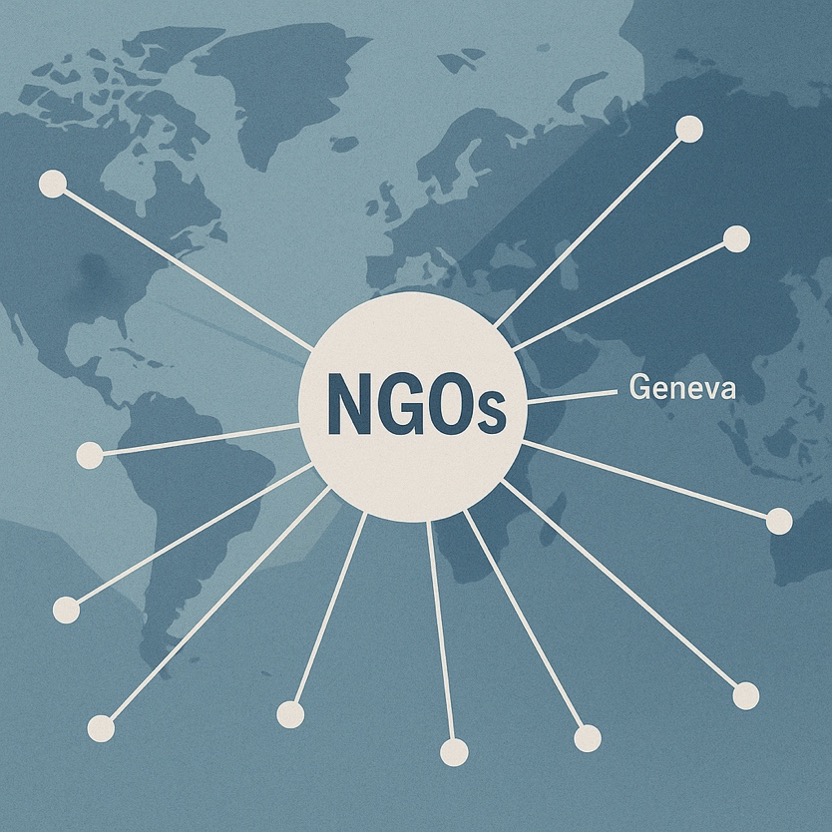
As the system recalibrates, NGOs face not only risks but also critical opportunities. When UN agencies contract, they often shed functions related to analysis, coordination, and civil society engagement. NGOs can step into these spaces by providing field-driven insight for Permanent Missions in Geneva and shaping global understanding of humanitarian realities in ways that strengthen the overall ecosystem.
At the same time, this period of transition offers a rare chance to push for deeper governance reform. ICVA, especially as it represents international, local, national, and refugee-led constituencies, can work to ensure that future structures embed more inclusive participation rather than default to old hierarchies.
This is also a moment to rethink humanitarian diplomacy itself. As global functions decentralise, diplomacy becomes more distributed, more digital, and more networked.
ICVA’s NGO members can shape models that are closer to affected people, more agile, and more attuned to diverse experiences.
And finally, in this shifting landscape, NGO-led networks such as ICVA become even more important. At a time when institutions are reducing or relocating their presence, networks are uniquely positioned to preserve continuity, maintain field-to-global connectivity, convene diverse actors, and ensure that NGO perspectives remain central to global policy processes.
Looking toward 2026
There is no doubt that Geneva will remain a humanitarian and human rights centre in 2026. The real question is not whether Geneva will continue to matter, but what kind of centre it will become and who will shape its future.
If NGOs respond passively, Geneva’s humanitarian role will narrow. It will become leaner, less inclusive, less influential, and further removed from the realities of crises.
But if NGOs step forward by asserting leadership, claiming space, and shaping new forms of humanitarian diplomacy, Geneva can emerge from this period as a more diverse, more agile, more field-connected global hub than before.
International Geneva stands at a crossroads. The ecosystem is shifting, and it is the NGO community that will determine whether Geneva’s next chapter is defined by erosion or renewal.
For organisations like ICVA, this is not simply a moment to adapt.
It is a moment to lead.