


13 November 2025
ICVA is pleased to publish Coordination in Transition: How NGOs are Navigating and Adapting beyond the IASC – Lessons from Iraq & Indonesia.
The paper draws insights from two very different contexts to examine how NGOs and other humanitarian actors must adapt when internationally led humanitarian coordination scales back and national leadership expands.
This launch brief highlights the cross-cutting observations and concrete challenges that surfaced in the report and its four case studies, further informed by a recent discussion in the ICVA Coordination Transition Working Group.

1) Transitions aren’t always linear – and they take time.
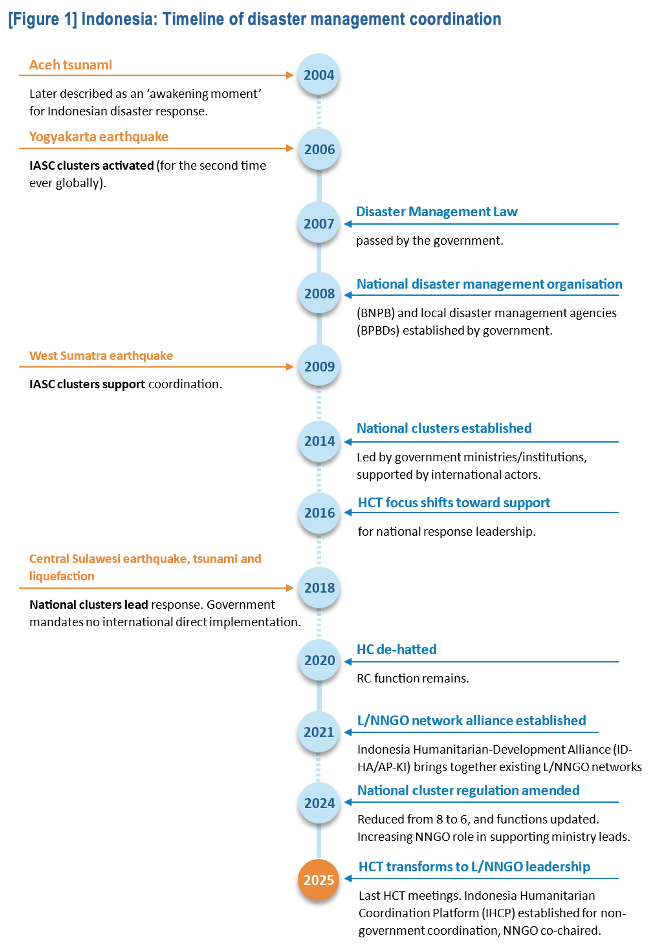
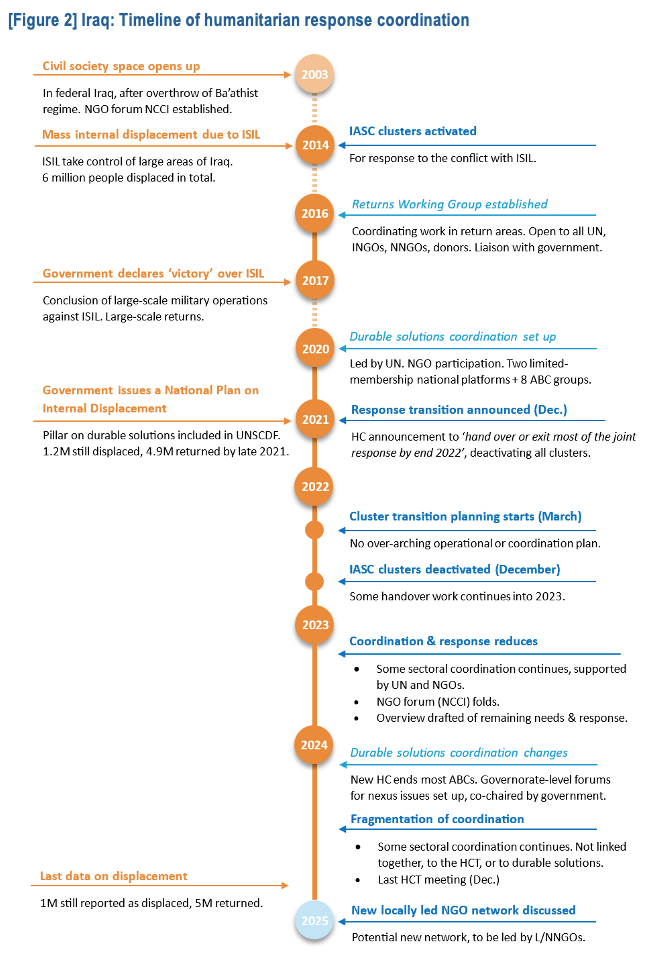
Iraq’s rapid deactivation of clusters in 2022, without an overarching transition strategy, left a gap in joint needs analysis, de-linked and uneven sector coordination groups, as well as a fragmented understanding of the evolving humanitarian situation. In contrast, Indonesia’s multi-year shift to national leadership took place over a decade but built incrementally more inclusive, nationally led arrangements (including government-led clusters and a new civil-society co-chaired platform). The timelines in the report (see figures below) show just how different the arcs can be between contexts.
Key message to NGOs: Plan for non-linear progress and set realistic timeframes.
2) Keep NGO forums in place and adapt them.
Both contexts underline the benefit of a structured, collective NGO voice. Indonesia’s networked civil society helped co-design the new nationally led Indonesia Humanitarian Coordination Platform (IHCP), as the Humanitarian Country Team (HCT) transitioned. In Iraq, the closure of the NGO forum created a critical void in information-sharing, representation, and advocacy. One explicit takeaway in the recommendations: “Don’t let your NGO forum collapse!”
Key message to NGOs: Incorporate resourcing requirements and governance adaptations for NGO fora at an early stage.
3) Fund the future you foresee.
Transitions typically come along with a funding decline (linked to the end of the Humanitarian Response Plan– HRP), meaning NGOs need to be realistic about trajectories and design coordination that fits the likely scale of work. Indonesia’s diversified domestic funding (especially public donations and zakat) has helped to underpin local leadership; Iraq’s heavier reliance on international grants made pivoting harder for many L/NNGOs. The report urges donors to sustain light-touch funding for NGO coordination roles and forums.
Key message to NGOs: Prepare for budget reductions. Diversify and localise resources where possible.
4) Make new coordination approaches simple, linked, and inclusive.
When clusters phase out, succeeding frameworks must be easy for all actors to understand and sustain, while also being clearly connected (national ↔ sub-national; sectors ↔ nexus/solutions architecture). A critical function is to ensure a light yet robust needs analysis and information management approach to support decision-makers. Iraq’s experience with establishing area-based coordination bodies demonstrates the challenges of setting up new coordination structures, particularly if ToRs change and ambitions exceed the available resources. The evolution of Indonesia’s nationally led clusters illustrates how steady coordination support – shifting from UN/INGO to NNGO leadership over time – can be crucial in building effective, resilient mechanisms. This example of NGO network-led operational coordination serves as an interesting model for consideration in other contexts.
Key message to NGOs: Keep it straightforward, with distinct roles, linkages between bodies, and streamlined coordination functions. Identify what NGOs require from coordination and consider if and how NGO-led systems can provide it.
5) Reimagine international actors as enablers.
Across both settings, international actors added the most value by (often quietly) facilitating national leadership, transferring operational capacity and expertise, while maintaining regional/global technical links. In Iraq, this is seen in the cash coordination space, where the Iraq Cash Forum, now led by an NNGO, remains connected to the regional CALP Network (read here for a deep dive into the cash transition). The report documents how reliable, low-visibility facilitation alongside dedicated government counterparts helped Indonesia embed nationally led clusters and launch the new IHCP.
Key message to NGOs: Transition does not have to mean exit, and regional/global support may become even more important.

1) Residual humanitarian needs risk falling between the cracks. After deactivation, the “big picture” can blur. As HRPs wind down, NGOs should be central to discussions on how remaining needs will be analysed and prioritised collectively (including with lighter, NGO-led products). This is particularly significant for protection-related objectives.
2) Government leadership and NGO space must both be safeguarded. As governments assume larger roles (often amid heightened state sovereignty narratives), NGOs still need protected spaces to coordinate on sensitive issues and advocacy. Indonesia’s choice to keep the newly formed IHCP as a non-government platform, while still engaging authorities, offers one practical approach.
3) Durable solutions aren’t a shortcut. Durable-solutions platforms can complement transitions, but they’re not a substitute for humanitarian coordination – and they rarely channel funding directly to NGOs. Early clarification of mandates, linkages, and expectations is essential.
4) Align with public finance realities. Successful handovers hinge on government budget cycles and capacities; overlooking these can stall planning continuity. Participants in our working group discussion stressed the relevance of timing asks and advocacy to national fiscal calendars.
5) Understanding the donor trajectory. Within a global landscape of shrinking humanitarian and development financing, NGOs should engage collectively with key donors that are committed to supporting the process and securing dedicated resourcing for coordination roles during and beyond the transition.

Accelerated transitions are now underway in multiple contexts simultaneously, which will test our collective ability to apply these lessons pragmatically in diverse settings such as Nigeria, Cameroon, and Colombia. This report shows the way to some clear shared priorities: keep NGO forums strong, simplify and link new coordination structures, plan for (and fund) light and effective coordination, reinforce local leadership, and emphasise international actors’ enabling roles.
We invite you to read the report, along with the accompanying four case studies, and share with colleagues who are planning, steering, or adapting through coordination transitions. ICVA members are further encouraged to join our Coordination Transition Working Group to contribute to future work supporting transitions to lean, linked, and locally led coordination that lasts.